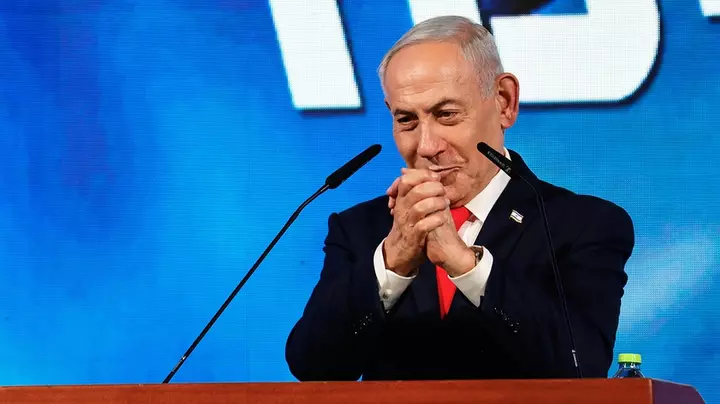
TEL AVIV, Israel — Prime Minister Benjamin Netanyahu's political bloc gained ground Wednesday morning as Israel counted votes from its first national election since the Oct. 7, 2023, Hamas massacre, but remained short of the majority needed to form a government, leaving the country facing another potential political deadlock. With approximately 70% of votes counted, Netanyahu's right-wing and religious bloc stood at 54 seats in the 120-seat Knesset, compared with 47 for the main opposition and 19 for Arab parties, according to partial election results reported by Israeli media. Netanyahu's Likud led with 27 seats, while former Israeli military chief Gadi Eisenkot's Yashar party held 20.
As both Netanyahu and Eisenkot claimed victory Tuesday night, Israelis told Fox News Digital that although they had expected a tight race, the shifting numbers and uncertainty over who could form a government had left many confused about what comes next. ISRAEL HEADS INTO DEEPLY DIVIDED ELECTION AS OCT. 7 RECKONING LOOMS: WHAT TO KNOW Despite Netanyahu's lead, the parties outside his governing bloc collectively held 66 seats, a majority in the Knesset 120 seats, creating a potential path for the opposition to challenge his leadership if it can secure sufficient cooperation from Arab lawmakers. The results marked a shift from Tuesday night's initial exit polls, which prompted celebrations at Eisenkot's campaign headquarters in Tel Aviv.
Eisenkot called on Netanyahu to accept the results and step aside, while Netanyahu declared later in the night from his headquarters in Jerusalem that Likud had emerged as the country's largest party and urged the formation of a strong right-wing government. The election has now shifted from the ballot box to a potentially complicated battle over coalition-building. President Donald Trump took credit Wednesday morning for Prime Minister Benjamin Netanyahu's stronger-than-expected election performance, suggesting his endorsement helped shift the momentum of the race.
NETANYAHU FIGHTS FOR POLITICAL FUTURE AS ISRAEL HEADS TO POLLS WITH IRAN THREAT LOOMING In a post on Truth Social, Trump shared a statement from Irving C. Schwartz, who wrote, "When President Trump endorsed Bibi Netanyahu, the whole tide turned, and now, rather than a decisive defeat for a Great Prime Minister, it looks like a big come-from-behind stalemate, or even a WIN for Netanyahu." Later, speaking to reporters near Air Force One, Trump said, "I heard the poll numbers were wrong... the exit polls; I heard he [Netanyahu] did very well. It was pretty close, but very well.
When the endorsement went out, it helped him a lot." "It's a little bit early, but I'm hearing in Israel, top people say, 'Wow! He did a lot better than people thought.' It's looking like maybe a stalemate or a win," Trump added. JD VANCE DECLINES TO ENDORSE NETANYAHU DESPITE TRUMP'S STRONG BACKING The growing influence of Arab parties has emerged as one of the most consequential factors in determining Israel's next government.
According to the partial results, the Joint List held 13 seats and Ra'am, led by Mansour Abbas, held six, giving Arab parties a combined 19 seats. Abbas signaled openness to political negotiations, saying figures from both sides of Israel's political divide had approached him. "Everyone is talking to us, not just the change bloc," Abbas told Israel's Channel 12.
Extract — continue reading at the source.