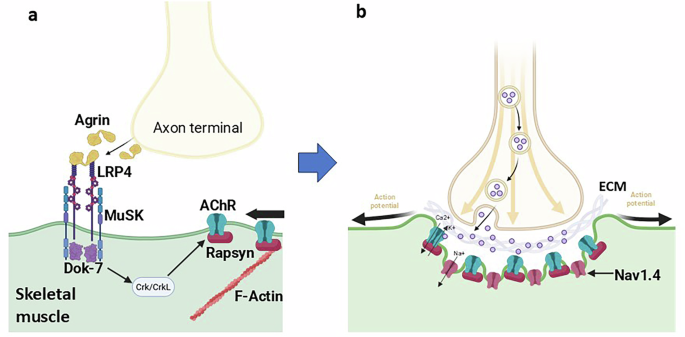
Traditionally conceptualized as a soma-centric pathology, amyotrophic lateral sclerosis (ALS) is a fatal, heterogeneous neurodegenerative disease. The suboptimal outcomes of central nervous system (CNS)-directed therapeutic strategies have necessitated a shift in focus toward the dying-back hypothesis. This hypothesis contends that synaptic disconnection and axonal retraction at the distal neuromuscular junction (NMJ) are early pathological events that may antedate overt motor neuron loss.
This review systematically examines the NMJ as an early vulnerable and therapeutically tractable peripheral niche in ALS pathogenesis, rather than merely a downstream consequence of proximal proteinopathy. Evidence from human clinical samples and ALS mouse models, particularly SOD1-G93A mice, collectively supports the early vulnerability of the NMJ, with the temporal precedence of denervation, synaptic retraction, and mitochondrial dysfunction most clearly demonstrated in experimental models. We highlight how the breakdown of the tripartite synapse—comprising the motor terminal, skeletal muscle, and terminal Schwann cells (tSCs)—may disrupt essential neurotrophic signaling and local metabolic homeostasis.
Furthermore, we discuss how advancements in humanized in vitro NMJ models and spatial transcriptomics provide unprecedented resolution into localized RNA dysmetabolism and bioenergetic failure. Finally, we evaluate emerging therapeutic strategies specifically designed to stabilize or restore the NMJ, including MuSK agonists and other NMJ-directed approaches. By recontextualizing the NMJ as a critical early site of vulnerability, we propose that targeting the peripheral synaptic microenvironment may offer a promising strategy for modifying the progression of ALS.
Amyotrophic lateral sclerosis (ALS) is a fatal, adult-onset disease characterized by the progressive degeneration of upper and lower motor neurons [1,2,3]. Traditionally, ALS has been considered a “soma-centric” disorder driven mainly by pathology in motor neuron cell bodies; however, accumulating evidence supports the “dying-back” hypothesis, in which distal axons and neuromuscular junctions (NMJs) become vulnerable early in the disease process. The NMJ is a chemical synapse where acetylcholine-mediated transmission occurs from motor neurons to skeletal muscle, and it has been established that synaptic disconnection at this distal synapse can precede overt motor neuron loss and clinical weakness [4].
To elucidate these complex pathological mechanisms at the periphery, the scientific community has long relied heavily on various mouse models, particularly SOD1 and TDP-43 mutant strains. The SOD1-G93A model [5], based on the ALS-causing SOD1 gene first identified in 1993 [6], recapitulates progressive impairment and has been instrumental for tracking NMJ pathology from the pre-symptomatic stage to the terminal stage—a process that cannot be observed longitudinally in humans [7]. Using this model, it has been demonstrated that morphological denervation of the NMJ and fragmentation of the synaptic plate occur weeks to months before symptoms appear.
Meanwhile, TDP-43 models have become indispensable for investigating a major pathological hallmark of ALS, because cytoplasmic TDP-43 mislocalization is observed in 90–95% of patients with ALS [8]. However, while these mouse models have yielded significant insights, there are important species differences between mouse and human NMJs in terms of size, structural complexity, and the dynamics of the surrounding tSCs [9]. These species differences have been a major barrier to translating promising results from preclinical studies using mice into clinical treatments for humans.
Extract — continue reading at the source.