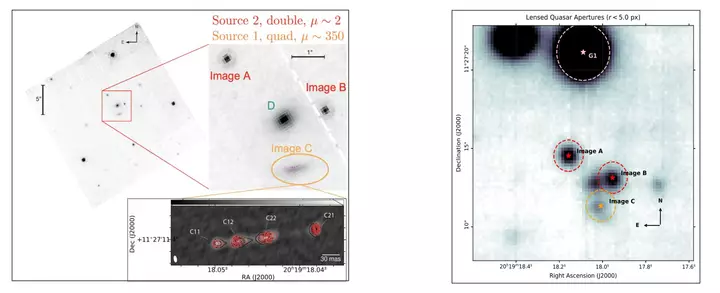
This article has been reviewed according to Science X's editorial process and policies. Editors have highlighted the following attributes while ensuring the content's credibility: Astronomers have found two actively feeding supermassive black holes separated by just 175 parsecs (570 light-years) in a galaxy seen when the universe was only about 2 billion years old. The system, MG B2016+112, lies at a redshift of 3.273 and is the most compact dual AGN known at this redshift.
The study was posted to the arXiv preprint server on Sept. 25. Models predict that galaxy mergers drive gas onto central supermassive black holes, so merging galaxies should sometimes host dual active galactic nuclei (AGN). Finding close pairs is hard because of observational limitations in distinguishing nearby bright spots.
Strong gravitational lensing is useful for observing these distant objects. It occurs when a massive galaxy between the object and observer warps spacetime so strongly that the background object's light is bent and magnified, producing multiple images, arcs or rings. By magnifying distant sources, it lets astronomers reconstruct the object and study it in depth.
This study, led by Jianghao Huyan and Júlia M. Sisk-Reynés, analyzes archival VLT/MUSE spectra of MG B2016+112, a radio-loud active galaxy at redshift 3.273 that is gravitationally lensed by a foreground galaxy into three images (say A, B and C). The team explores whether the system hosts one actively feeding black hole or two.
Earlier radio and X-ray studies had suggested two, about 175 parsecs (around 570 light-years) apart. The current study conducted an independent test and made new measurements using spatially resolved optical spectra of all three images. Using the archival MUSE data from 2018, they extracted spectral information for each of the three lensed images.
They made corrections to remove absorption from our galaxy's gas. They also masked absorption from gas near the quasar. Next, they measured the strengths of prominent emission lines—such as those from hydrogen, nitrogen, carbon and helium—that appeared in the three images.
Extract — continue reading at the source.


