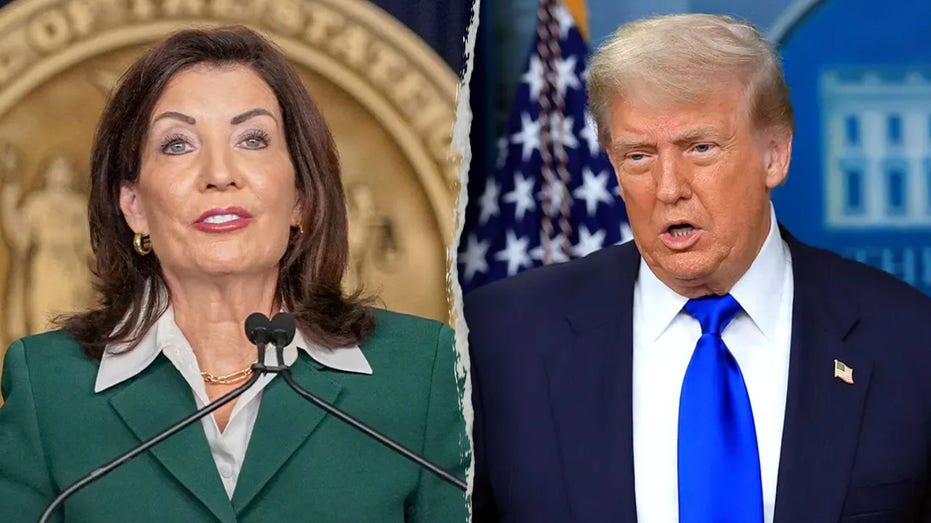
Kathy Hochul on Thursday responded to President Donald Trump's executive order to rename Lake Ontario to "Lake America" amid his ongoing trade war with Canada, saying her state would continue using the old name. "New York won’t be calling it that," Hochul, a Democrat, wrote on X. Trump's order, directs the Interior Department and Board on Geographic Names to update federal records and provide guidance so federal references reflect the new name.
But Canada and international bodies are not required to adopt the new name. TRUMP RENAMES LAKE ONTARIO 'LAKE AMERICA' AMID INTENSIFYING US-CANADA TRADE DISPUTE "The name Lake Ontario comes from the Wendat word Ontari’io, which, appropriately, means 'the lake is beautiful, the lake is big.' The name is more than 400 years old, predating both the Confederation of Canada and the Declaration of Independence of the United States of America," Canadian Prime Minister Mark Carney said in a statement. "We know that America is changing.
Their trading relationships, their foreign policies, their national monuments, their hydronyms. Canadians also know that naming reality means calling it Lake Ontario — then, now and always," he added. U.S. states are also not bound by the order and can continue using "Lake Ontario" on state maps, highway signs and tourism materials.
Tony Evers and Vermont Gov. Phil Scott were among state leaders who criticized or mocked the move. "And I just renamed Lake Michigan Lake Wisconsin.
See, I can sign napkins that say things, too," Wisconsin Gov. Tony Evers, a Democrat, wrote on X alongside a video of himself writing "Lake Wisconsin" on a McDonald’s paper napkin and signing the bottom. Phil Scott, a Republican, called Trump's move to rename the lake over the trade feud "petty and disappointing." "We should be at the negotiating table, finding a path forward that strengthens both the U.S. and Canadian economies.
Further escalating tensions does nothing to help American or Canadian families and businesses," Scott said. The name Lake Ontario is also commonly traced to an Indigenous word translated as "lake of shining waters," and includes around 5.6 million Americans and Canadians in its watershed, according to the Center for Great Lakes Literacy. The lake borders Canada's Ontario province and New York, connecting the Great Lakes to the Atlantic Ocean through the St.
Extract — continue reading at the source.