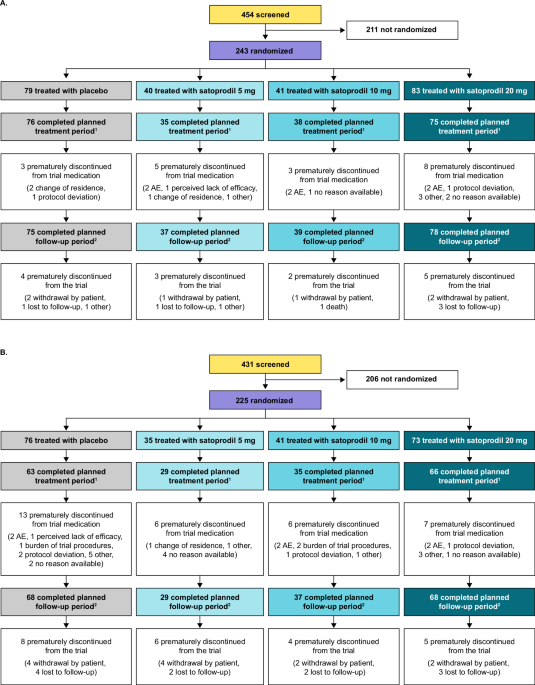
Major depressive disorder (MDD) is a leading cause of disability worldwide, with many patients experiencing inadequate response to standard antidepressants. Dysregulation of N-methyl-D-aspartate (NMDA) receptor activity is implicated in the pathophysiology of MDD. Satoprodil (BI 1569912), an oral NMDA subunit GluN2B-selective negative allosteric modulator, was evaluated for safety and efficacy in MDD in two multicenter, randomized, placebo-controlled Phase II dose-finding trials as an adjunctive or monotherapy.
In each trial, patients (18–65 years old) were randomized 2:1:1:2 to placebo or satoprodil (5 mg, 10 mg, or 20 mg) once-daily for 6 weeks, with ongoing antidepressant treatment in the adjunctive trial. Primary endpoint was change from baseline in Montgomery-Åsberg Depression Rating Scale (MADRS) total score at Week 6 (both trials). Safety and tolerability were also assessed.
In the adjunctive trial (N = 243; 60.9% female), the adjusted mean (standard error [SE]) change in MADRS total score at Week 6 was: placebo, –12.0 (1.1); satoprodil 5 mg, −7.8 (1.6); satoprodil 10 mg, −11.9 (1.6) and satoprodil 20 mg, −12.3 (1.2). In the monotherapy trial (N = 225; 54.2% female), the adjusted mean (SE) change in MADRS total score at Week 6 was: placebo, –10.3 (1.4); satoprodil 5 mg, −13.6 (2.1); satoprodil 10 mg, −10.6 (2.0) and satoprodil 20 mg, −10.0 (1.4). In patients with MDD, satoprodil (all doses) over 6-weeks was well tolerated but did not reduce depressive symptoms beyond placebo in either trial in a relevant manner.
These trials provide the most comprehensive clinical evidence to date on GluN2B-selective modulation in MDD and will inform future research on glutamatergic pathways. Major depressive disorder (MDD), a leading cause of disability worldwide, is characterized by persistent low mood, anhedonia, and cognitive impairment [1, 2]. Despite the availability of multiple antidepressant classes, a substantial proportion of patients, particularly those with moderate-to-severe symptoms, fail to achieve adequate response [3, 4].
Adjunctive treatment strategies are often required, yet current options remain limited and are frequently associated with suboptimal efficacy or tolerability [5,6,7,8]. The burden of MDD underscores the need for novel therapeutic approaches that target alternative neurobiological pathways beyond monoaminergic systems [9]. Within the N-methyl-D-aspartate (NMDA) receptor family, GluN1-N3 subunits play critical roles in determining receptor kinetics, localization, and downstream signaling [10, 11].
GluN2B subunit-containing NMDA receptors (formerly NR2B) are distinguished by their unique distribution and functional properties within the central nervous system, making them attractive targets for drug development. GluN2B-selective negative allosteric modulators (NAMs) may offer therapeutic benefits while minimizing off-target side effects often associated with activity at other subunits [10, 12,13,14]. Efficacy in MDD has been demonstrated with intravenous GluN2B NAMs onfasprodil and traxoprodil as an add-on to antidepressants in small clinical trials (NCT03756129, NCT00163059).
Extract — continue reading at the source.


