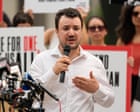
Mahmoud Khalil was completing a master’s degree at Columbia University when, in March 2025, plain-clothed officers from the Department of Homeland Security snatched him from his home in New York and took him to an immigration detention centre; he was then transferred to another facility in Louisiana, more than 1,000 miles away. As a green card holder, Khalil has permanent US residency, but secretary of state Marco Rubio had determined that his continued presence in the country would have “adverse foreign policy consequences for the United States”, and sought his deportation under a legal provision dating back to the McCarthy era. Khalil was released on bail in June 2024 after a federal judge ruled his detention unconstitutional, but the Trump administration is still trying to have him removed.
Khalil – who was born to Palestinian parents in a refugee camp in Syria – had been targeted because of his advocacy on behalf of pro-Palestinian protesters during campus protests over Columbia University’s links to Israel. They were calling for Columbia to cut its ties with Israeli academic institutions and companies profiting from Israel’s onslaught on Gaza; in response, the university called in the NYPD. There was no suggestion that Khalil had done anything unlawful, and no criminal charges were brought against him; the government had simply identified him as an influential pro-Palestinian voice on campus, and for that reason alone they wanted him gone.
He spent a total of 104 days in detention, missing the birth of his son. Khalil recounts this Kafkaesque ordeal with a quiet fury in his memoir, No Land to Stand On. The episode is a damning snapshot of the Trump administration’s creeping authoritarianism and the cruelty of its immigration enforcement policy.
Khalil was a high-profile detainee whose case drew considerable public scrutiny; he had access to lawyers, and was eventually able to extricate himself. Many of his fellow prisoners at the facility, hailing from places as diverse as Georgia, Romania, Senegal, Nepal, El Salvador and Chechnya, were less fortunate. They languish in detention for months on end, at the mercy of an opaque and glacially slow legal bureaucracy, “forgotten in a system designed to forget them”.
Khalil notes that the private ownership of the detention centre produced a perverse incentive structure. It “was not operated by the government, it was operated by shareholders. By people who made money when beds were filled and lost money when they were empty … Every man in this facility was a line item on a balance sheet.
Every day we spent here was revenue.” This might explain why, whenever an asylum claim is successful, the state appeals the decision as a matter of course, needlessly extending the applicant’s detention by many more months. So much for the land of liberty. At Columbia, too, the prerogatives of the private sector impinge on the public interest.
Extract — continue reading at the source.