Afoot and light-hearted I take to the open road, Healthy, free, the world before me, The long brown path before me leading wherever I choose. These words of Walt Whitman’s—from his poem “Song of the Open Road”—were originally published in 1856 in the second edition of Leaves of Grass, three decades before Karl Benz invented the first modern, gasoline-powered automobile, yet his descriptions of the road in that poem anticipate the iconography, the allure, and the promise of the coming car culture. In the 170 years since Whitman first wrote these words, not only did car culture emerge and evolve, but it did so on a parallel course—like two lanes on a highway separated only by a broken white line—with a new artistic medium: cinema.
Perhaps it’s no surprise, then, that the open road has become one of film’s most iconic images. You can picture it: The car speeding down the highway, radio up, windows down. The winding road snaking toward a fixed point on the horizon beneath a still blue sky.
This tableau appears encased by the windshield, as if under a glass bell. In relation to a pair of snow-capped mountains in the distance, the car barely seems to move, locked in some sort of suspended animation. Though motion parallax makes us feel like we’re not getting any closer to those massive objects in the distant landscape, the blur of the roadside objects that line the highway—an indistinct parade of buildings, restaurants, gas stations, overpasses, trees, telephone poles, tourist traps, muffler men, rock formations, billboards, street signs, roadkill—reminds us that we’re moving at great speed.
And in the rearview mirror, what we’ve passed—and made past—recedes. We’re headed off into the unknown, the long black highway before us leading wherever we choose. It’s an image of escape, of movement, of adventure, of self-discovery, of individualism, and—most of all—of freedom.
But these heavenly highways that populate our collective imagination are shown to be something altogether different when they appear in the horror genre: there they expose themselves as highways to hell. As I’ve argued previously, if houses promise safety, then the house in horror reveals that safety as nothing more than an elaborate illusion, an attractive façade. Likewise, if roads promise freedom, then the road in horror proves this freedom to be a mirage.
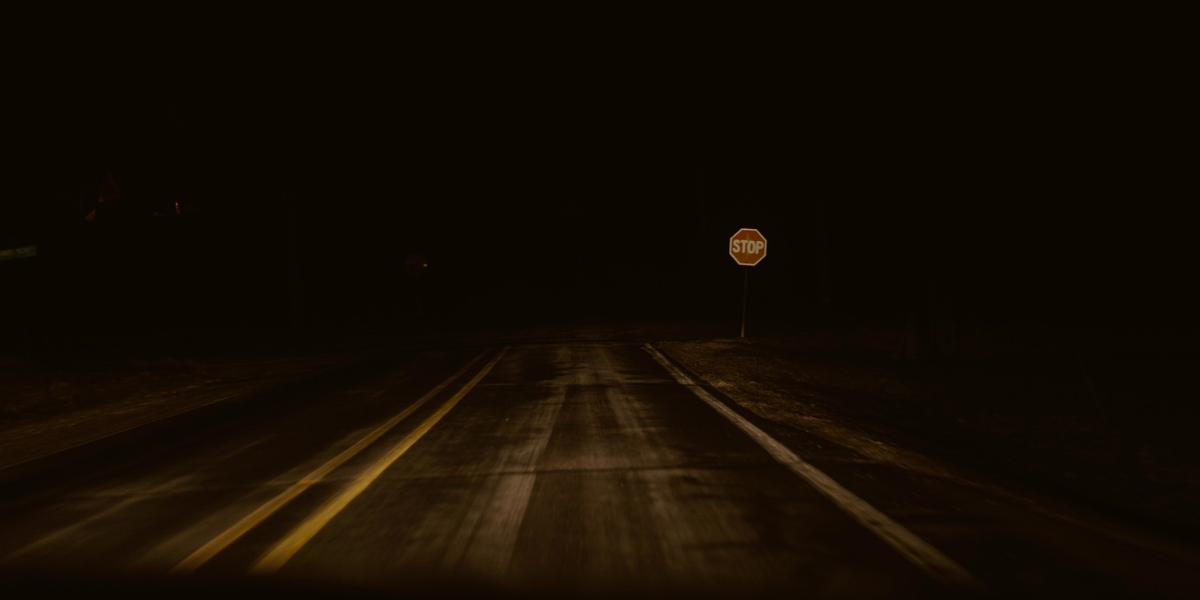
No matter how far you drive you can never escape yourself. In the horror genre, the automobile shines its brights on the always-already-terror, that occulted world living in the shadows of our own, that is—and always will be—fundamentally un-understandable, though all we ever see are the few illuminated lane lines that stretch out before us on the road ahead and the looming darkness that swallows up everything beyond the tapering light of our headlamps, as in the title sequence of David Lynch’s Lost Highway. No One Really Drives Away from Anything When we peep in on a hotel room at the beginning of Alfred Hitchcock’s Psycho, two of the first things we see are Janet Leigh’s breasts in a white bra, like those two towering snow-capped mountains on the horizon.
Extract — continue reading at the source.