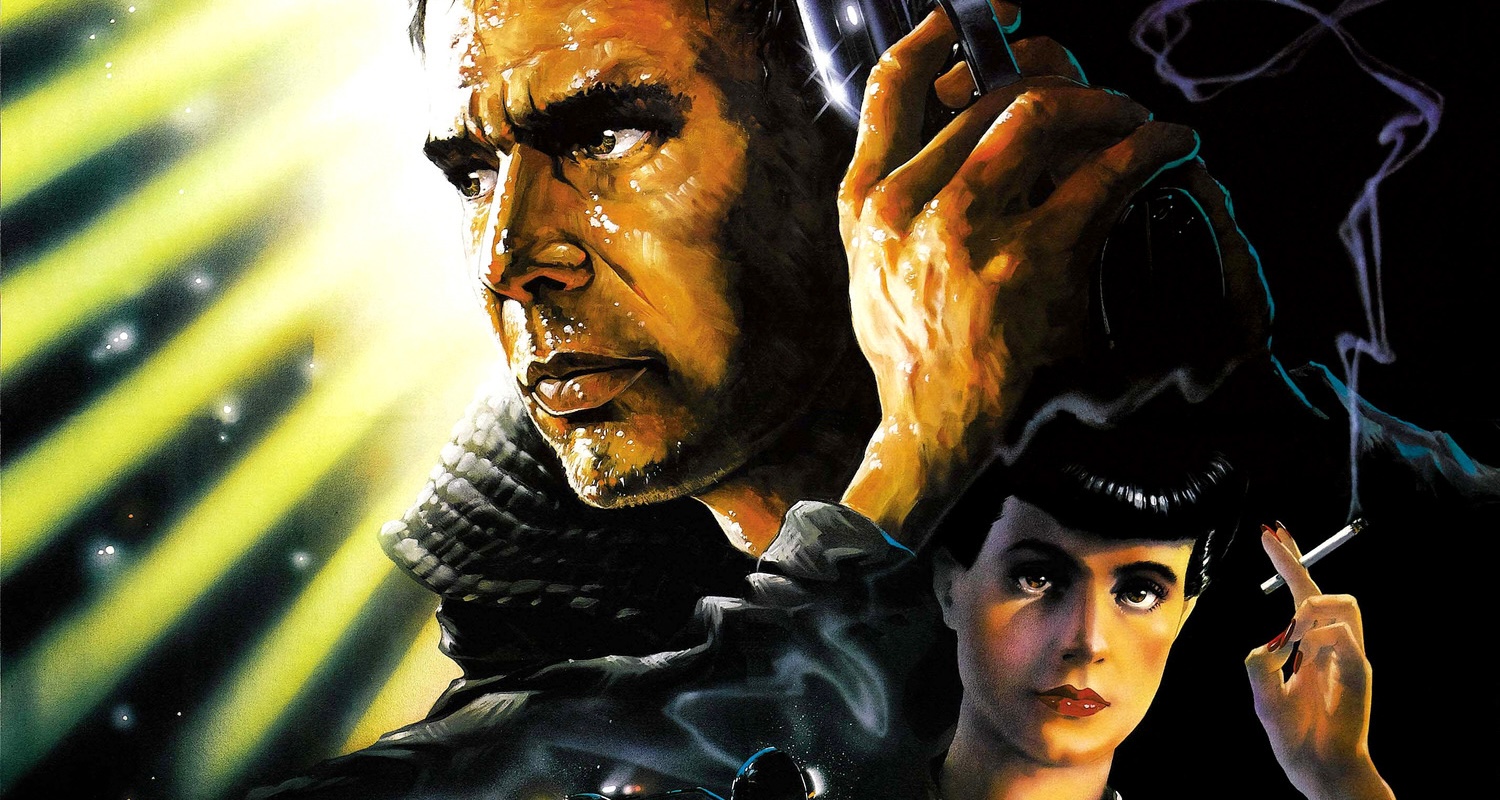
Ninety minutes and change of what transpires on the screen singes your mind’s eye and once it happens, it stays. When the lights switch on and the credits roll, you are left with ashes of memory like recollected experiences of your own. Blade Runner is a film that I have lived inside.
Some part of me stubbornly refuses to believe that I’ve never actually been to Taffy’s Snake Pit, jostling with the lowlifes for a seat at the bar, nor have I ever sought shelter from the rain with a steaming bowl of noodles before me at the White Dragon downtown. I have, in fact, been to the Bradbury Building—many times, always as a tourist—and each visit, it feels like returning to a place I used to go at a more restless time in my life. There’s a reason why Ridley Scott’s 1982 film burns so true.
I see it in one of the photographs Stephen Vaughan captured on the set. Harrison Ford as Rick Deckard leaps between two futuristic taxi cabs. Behind him, the sign for The Snake Pit beckons in neon curlicue script.
In the foreground are pedestrians styled in punk haircuts and black leather attire. Next to them are Hare Krishnas in orange robes. In the distance, there’s a man with a face and a fedora reminiscent of Philip Marlowe except he’s carrying an umbrella with a stem that glows.
If the power of the film is as the sum of its parts, Vaughan’s photography isolates these parts to reveal a city vernacular. The camera will follow Deckard along his violent journey to retire an android “replicant” on the loose in Los Angeles, but Vaughan’s photograph lets us linger on the rich detail of the city where he lives: strange to the viewer, but ordinary to Deckard. As an image instead of a scene, a frozen moment instead of a sequence, the full breadth of possibilities and choices made by the filmmaker and his crew are contained for us to consider.
What would happen if we followed the punks or the Hare Krishnas to wherever they are going? What if we took a ride in one of those cabs? The extras, the costumes, and the sets are all varied the way that real cities are: with subcultures, countercultures, clashing architectures, and retro cliques.
Extract — continue reading at the source.