Here we are, bewildered miracles of chemistry and chance, trembling embers of dead stars capable of sign and song, a wild bet against probability that won. We have dreamt up origin myths and cosmological models, built the Taj Mahal and the Large Hadron Collider, to fathom where we came from and where we are going. We have invented mathematics to describe the mystery we live in and poetry to describe the mystery we are.
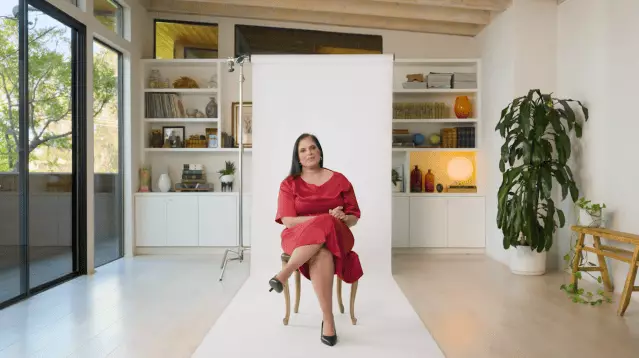
But beneath it all, we are born knowing — though we spend our lives unlearning — the elemental truth about us: A human being is a living question the only answer to which is love. That is what emanates from the pages of Azita Ardakani’s uncommonly wonderful Ocean of Stars (public library). Like all great children’s books, it is a work of philosophy disguised as a painted poem — one Azita composed while trying to conceive her first child, reckoning with the alien wonder of how a small universe could grow inside the ocean of her body.
Having grown up with a Sufi mother and made a home in the biological sciences, she weaves together scientific fact and poetic truth into a modern cosmogony that unfolds like a lullaby, a prayer for belonging, a blessing for life. The story came to her the way love does — unbidden, unreasoned, unasked for: a visitation of extraordinary clarity in a moment of pure presence with wild nature, arriving so fully formed that she had to run home from the forest to transcribe it. Artist Rebecca Rebouché, who had never worked on a children’s book before, created a breathtaking visual language to meet the story’s whimsy, painting on a single master canvas more than seven feet wide, then dividing it by the golden ratio into frames to make each spread of the book.
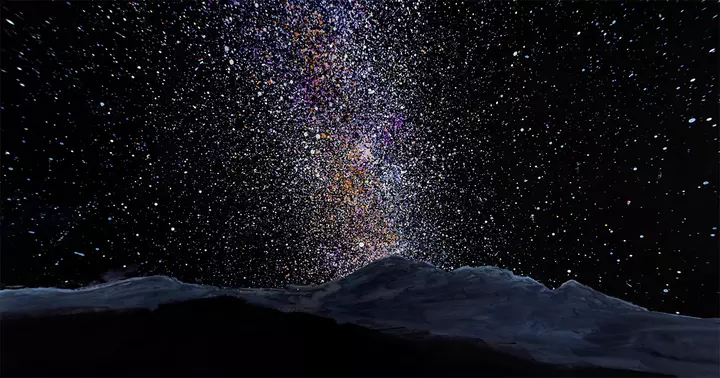
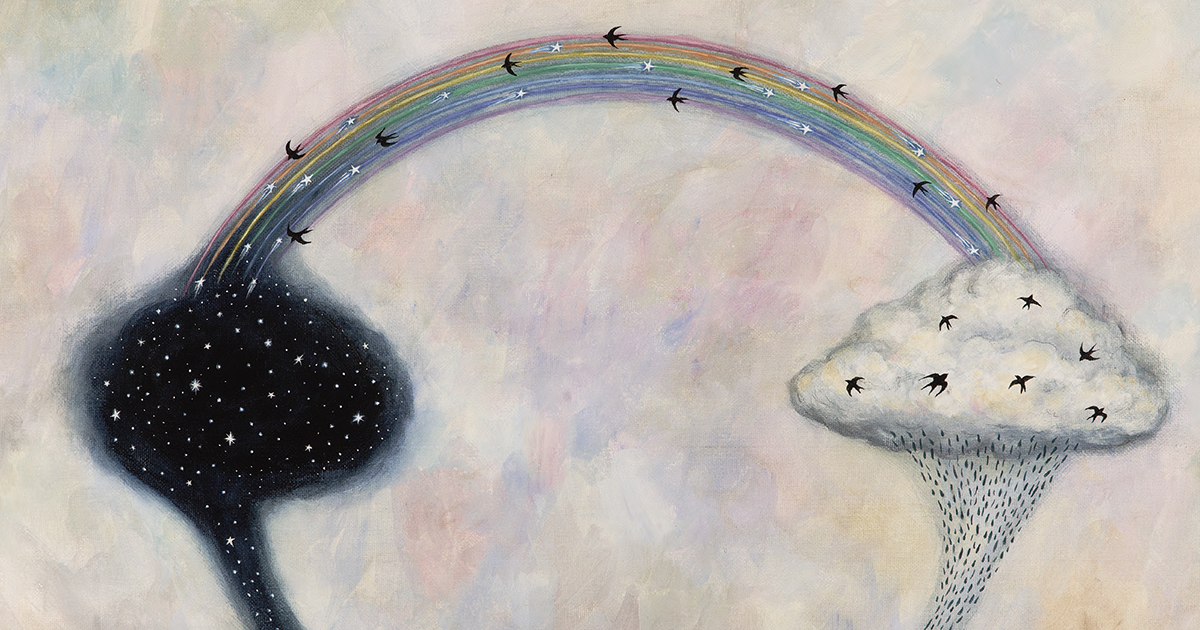
Once upon a time, in a far away place, darkness drifted, knowing no time. Reaching for infinity, only knowing beyond. One day, in the web of inky endlessness, it asked itself: “Can I see you?” And then, in answer, a star.
And then another and another and another. Another is where reflection began. As the cosmological story moves from stars to sentience — we see our Pale Blue Dot form “to reflect the stars back to themselves,” we see the “star beings” constellate out of the cosmic dust and descend “to touch the ocean, to greet themselves” — a sense of interbeing begins to emerge, a tender awareness that without this reflection, without this reciprocity between thing and thing, between one and all, nothing would exist.
The water stars stretched onto the soil, mixed into the clay, and became… everything. Mixed from clay and star, flesh and breath, a hollow canal opened so life could reach back to the darkness. Page by page comes the quickening that this is not a myth of creation but a truth of homecoming, not a new learning but an elemental remembering.
Extract — continue reading at the source.