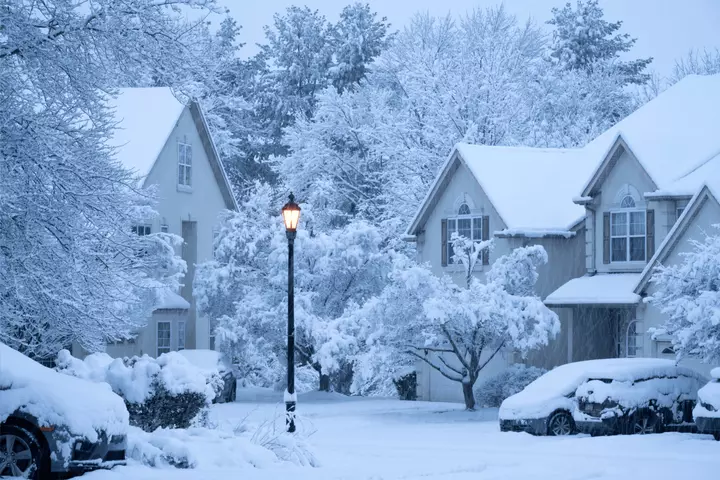
Americans hoping to wake up to snow on Christmas morning may have their best chances in three regions, according to a new long-range forecast from The Old Farmer’s Almanac. The publication predicts a white Christmas in the Northeast, Intermountain region, and Alaska in 2026. Several other regions, including the Pacific Northwest, High Plains, Lower Lakes, and Ohio Valley, have a “chance of a white Christmas.” The outlook is less promising across much of the South and central United States.
The Atlantic Corridor, the Southeast, Florida, the Deep South, the Upper Midwest, Heartland, Texas-Oklahoma, the Desert Southwest, and the Pacific Southwest are not expected to have a white Christmas. Hawaii is also forecast to miss out. In the Appalachians, the forecast is divided: northern areas aren’t expected to see a white Christmas, while southern parts of the region might just have a chance.
A “white Christmas” doesn’t necessarily mean that snow has to fall specifically on December 25. According to the National Weather Service (NWS), a “white Christmas is officially defined as having at least 1 inch of snow on the ground at 7 am local time Christmas Day,” so earlier snowfall could still make it a white Christmas if at least one inch of it is still there on Christmas morning. The regions with the best chance of a white Christmas generally coincide with areas where the Almanac expects “above normal” snowfall this winter, including parts of the Northeast, Appalachians, some western parts of the U.S., including the Intermountain region, and Alaska.
In the Northeast, for example, the southern part of the region is expected to experience above-normal snowfall, with one of its snowiest periods forecast for mid- and late December. That timing could allow snow to accumulate right before Christmas and remain on the ground until December 25, qualifying it for an official white Christmas. Northern parts of the region, however, are forecast to receive below-normal snowfall for the winter overall, meaning they’re probably less likely to experience a white Christmas.
The Intermountain region could also see more snow than usual this winter, boosting its chances of a white Christmas, and the Pacific Northwest is also expected to receive above-normal snowfall, although the Almanac gives that region only a “chance” of a white Christmas rather than predicting one outright. Its forecasts began as a practical tool to help farmers and gardeners plan for the year ahead. The Almanac produces its long-range forecasts by combining solar science, climatology and meteorology.
It also considers historical weather patterns, current solar activity, climate data, and large-scale climate signals when developing forecasts. The NWS’s Climate Prediction Center (CPC) produces official U.S. long-range climate outlooks, including eight-to-14-day, monthly and seasonal outlooks that give probabilities for above-, near- or below-normal temperatures and precipitation. The Almanac’s white Christmas forecast offers an early indication of where snow could be on the ground on December 25, rather than a solid prediction of Christmas morning conditions.
Extract — continue reading at the source.