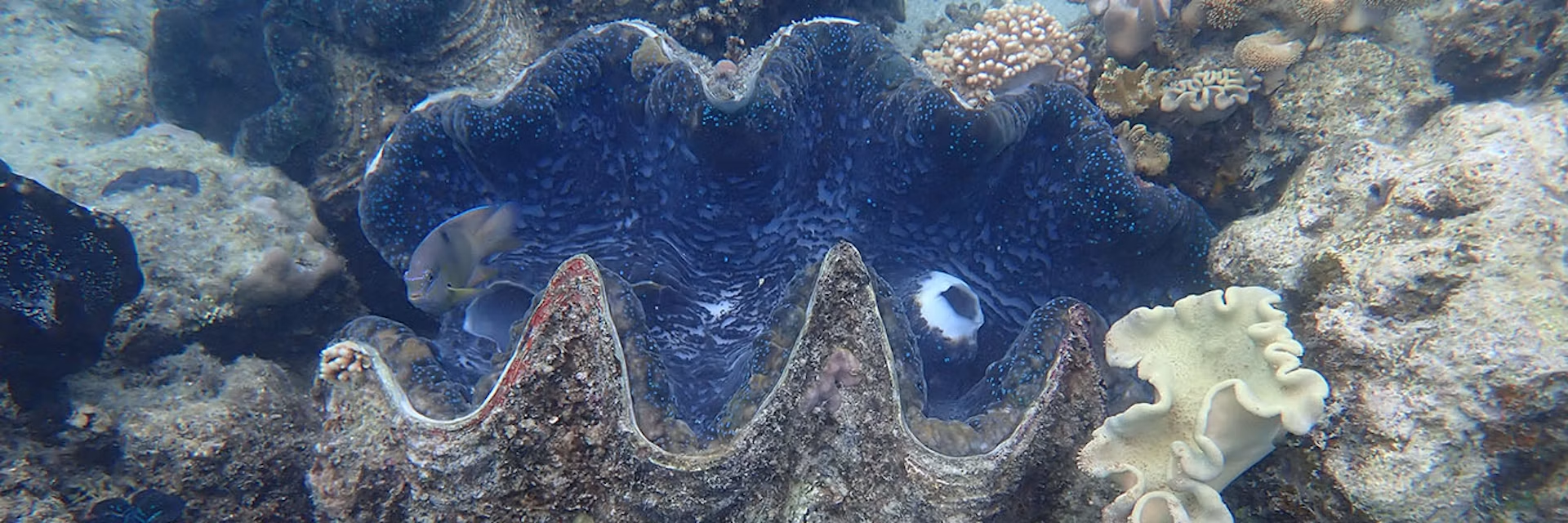
When you swim through the azure waters of the Great Barrier Reef, there is one entity on the seafloor that’s almost impossible to miss: the giant clam. Its huge, fluted shell frames a soft mantle shimmering with electric blue, green and gold. As the world’s largest living bivalve, Tridacna gigas can reach 1.2 metres, weigh more than 200 kilograms and live for over a century.
Across their long lives, these clams record their daily life in their shells, creating an autobiographical shell diary. In our new research, we read one of these shell diaries to reconstruct month-by-month climate conditions at Jiigurru (also known as the Lizard Island Group), in the northern Great Barrier Reef. The shell’s story reveals that, before widespread industrial-era warming, Jiigurru’s summers were cooler than today, while winters were surprisingly similar.
As a giant clam grows, the cycle of day and night produces microscopic daily lines in its shell, while the changing seasons produce broader annual bands. Like tree rings, these layers turn the shell into a diary. The growth lines provide the dates, just as we date entries in our own diaries.
The surrounding seawater writes the content by shaping the chemistry of each new layer. Geochemistry is the language in which this climate diary is written. By reading that language, climate researchers can decode how the reef environment changed during the clam’s long lifetime.
Today, instruments on land, in the oceans and in space constantly measure the changing climate around the world. But these direct observations cover only a small slice of Earth’s history. To look further back, researchers need to turn to other climate archives: records preserved in tree rings, corals, ice cores, lake and ocean sediments, and shells.
Yet many of the most detailed records before industrial-era warming come from the Northern Hemisphere and from high latitudes. Tropical oceans in the Southern Hemisphere are much less well documented. Giant clams live across the tropical Indo-Pacific.
Extract — continue reading at the source.