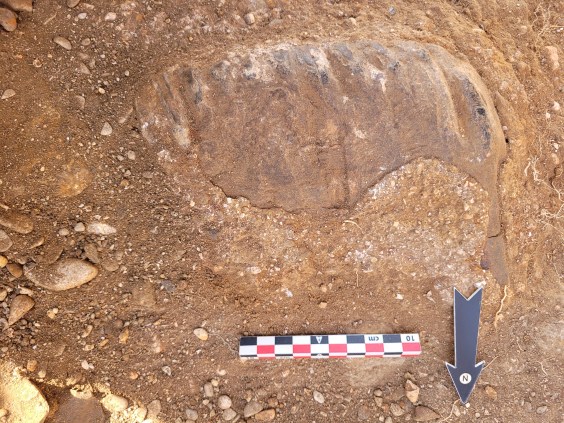
Long before it became a place where modern humans and Neanderthals mingled, the narrow land bridge linking Africa to Eurasia proved to be a popular thoroughfare for other ancient hominins who settled in the region (most likely Homo erectus and Homo heidelbergensis). Unfortunately, there’s still a lot we don’t know about the paleoclimate there, but we recently got some clues thanks to an elephant’s tooth. The tooth, dated to around 700,000 years ago, was discovered alongside tusk fragments and a cache of basalt hand axes from the same period in the Daughters of Jacob Bridge region just south of Israel’s Hula Valley.
A research team led by archaeologists from Haifa University performed some high-tech dentistry on the tooth, employing CT scans, 3D construction, and isotopic analysis, and recently published their results in Quaternary Science Reviews. Read more: “Here’s What the Whiskers on an Elephant’s Trunk Do” According to their analysis, the tooth belongs to the extinct straight-tusked pachyderm Palaeoloxodon antiquus—one of the largest mammals to ever live (and much bigger than modern elephants). While that’s impressive in its own right, it also contains a kind of bioarchive of what the prehistoric Levant was like when these mysterious hominins left their hand axes behind.
The carbon isotopes within the tooth indicate its owner lived in an environment where water was plentiful. Patterns of microwear show the elephant fed on vegetation commonly found in woodlands and river environments. Pollen grains found surrounding the tooth originated from aquatic plants, reeds, and willows.
Taken together, the analyses paint a picture of a lush landscape of woodlands and marshes—an idyllic place for ancient hominins and elephants alike. Subscribe to our free newsletter. Lead Image: Tel-Hai University of Kiryat Shmona/Hannah Farrell, University of Haifa
Extract — continue reading at the source.


/https://tf-cmsv2-smithsonianmag-media.s3.amazonaws.com/filer_public/a1/be/a1bec4ea-0428-4b24-bd7e-a84a00f9fe79/dsc_4882.jpg)

/https://tf-cmsv2-smithsonianmag-media.s3.amazonaws.com/filer_public/07/62/07625028-14a0-4437-a78e-d2d14b703eec/turner.jpeg)