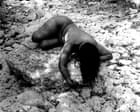
In the 1990s, the late Chicana artist Laura Aguilar was living with depression. A friend took her on a road trip to New Mexico, where Aguilar made some nude self-portraits in the mystical landscapes. Those photographs evolved into a pivotal series shot in desert environments across the American south-west, Aguilar’s notable 1996 Nature Self-Portrait – considered an early work of intersectional feminist art, before the word had entered academic discourse.
London gallery Autograph first worked on an exhibition of Aguilar’s in 1997, the year after she made Nature Self-Portrait, so this is something of a homecoming, a generation on. Aguilar’s contours, folds, and crevices sometimes disappear into the barren desert landscapes, assimilating the shapes of boulders or trees; at other times, her body is incongruous, soft flesh that can’t be held by the harsh, barren conditions. These images capture the paradox of a body that is both hypervisible and ignored.
Several works from Nature Self-Portrait appear at the beginning of Our Bodies Have Been Bridges, Autograph’s new three-person headline show. They’re so quiet and minimal, shot in black and white, they’d be easy to coast past – which is partly Aguilar’s point. Bodies like hers – large, queer, Chicana – had no visibility in culture at the time Aguilar made these works, while in real life her experiences were of an uncomfortable, scrutinised presence.
Out here in the terrain of nowhere, Aguilar returns her body to the earth – a body wanting to just be a body, to not ache to fit in. A body with the same cracks, dents and curves as the land; hardy, wild and free. They’re photographs about rejection, but also embrace.
This is the beginning of three concurrent exhibitions at Autograph about rebellious bodies. In the first and largest, Our Bodies Have Been Bridges, Aguilar’s story continues through two younger artists who also use their bodies as anchors, in pursuit of healing, truth and connection to ancestral female knowledge. In a diaristic, family album-style account of matriarchy and ritual, Other Stories/Historias Bravas, the artist Koyoltzintli re-enacts remembered scenes from her childhood in the Andean mountains of Ecuador.
Her bare breasts are blessed by her aunt, for protection. In another picture, her mother braids her hair tenderly, the same way, the caption tells us, her grandmother had once done for her. Her mum takes her to sit among the iguanas at the local park, to cure her of her phobia of the reptiles.
Extract — continue reading at the source.