Like many teenage best friends, Evi and Vanessa have a penchant for finishing each other’s sentences. Whether enmeshed on a couch or telling a story, one, a red-headed musical theater nerd with a personality nearly as boisterous as her signature puffy skirts, collides with the other, darker in hair and disposition, their speech bubbling with indecipherable affirmations and giggles. In a heady chorus of “duuude” and “no, you!”, it can be difficult to tell where one girl ends and the other begins.
Except, that is, at their respective homes. Evi’s mother, Lela, who like her daughter, espouses views considered left of liberal in the US context, speaks in support of LGBTQ students at local school board meetings and advocates for fact-based history lessons. Vanessa’s father, Paul Martino, is a right-leaning venture capitalist who likes to brag about installing school board members by spending $500,000 on local campaigns, an effort triggered by what he saw as unjustified school closures in the wake of the Covid-19 pandemic.
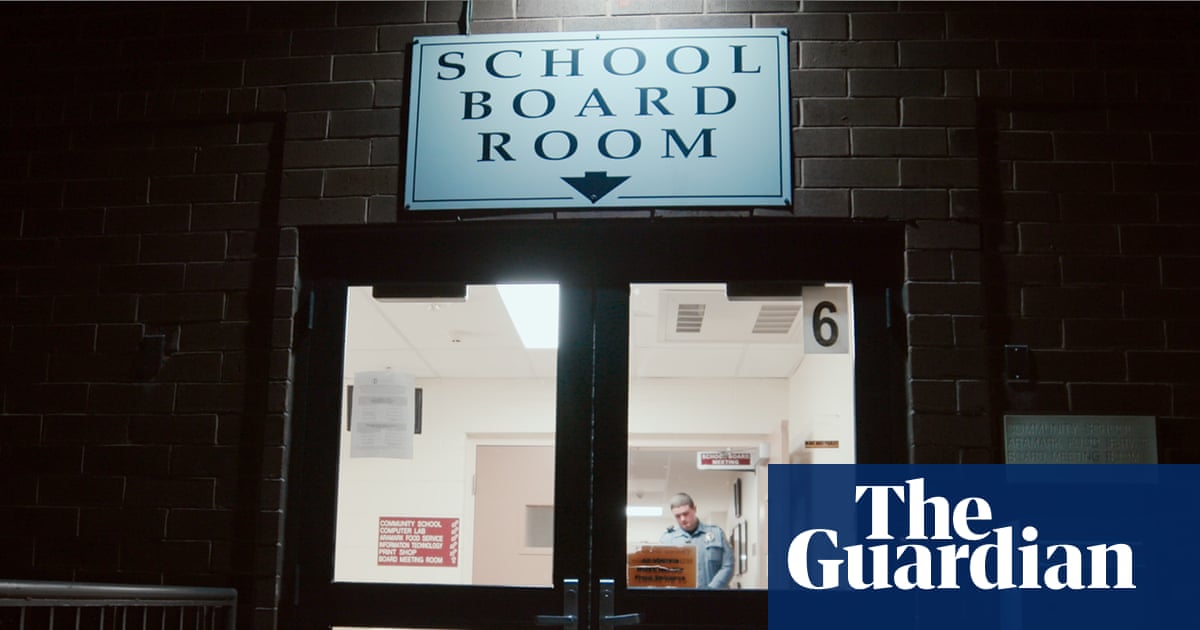
That their parents do not see eye to eye is an understatement; both are actively involved – on social media, on Zoom and in the meeting room – in lobbying their local school district board, and frequently call out the other by name. Like many towns across the US, the girls’ home in Doylestown, Pennsylvania, an affluent district north of Philadelphia, has been roiled by the political and cultural currents triggered by upheaval of Covid-19. Seemingly overnight, concerns that simmered in various social media forums and side chats – the legality of masking, critical race theory, DEI, slavery, election conspiracy theories and viral fixations over transgender students and bathrooms – concentrated in perhaps the one unifying place in town: the school, and in particular its governing board, whose public meetings frequently ended in ugly shouting matches.
Evi and Vanessa may open each episode of Bucks County, USA, a new five-part PBS docuseries embedded in one emblematically polarized town, in unison, but the adults, it seems, could not stop fighting. The series, directed by Robert May and Oscar-winning film-maker Barry Levinson, of Rain Man glory, and filmed over four highly contentious years, plays out a roving gallery of 2020s US politics in miniature – a “microcosm for communities around the country”, said May, where concern for one’s children morphs and mutates into hardline stances. Good intentions and, at times, bad information collide with pride in familiar, if fascinating and infuriating, stalemates.
Pushback to the district’s mask policy and Covid closures, along with Martino’s money via a Pac, fueled previously inconceivable attack ads and fake fliers. A new conservative majority on the board had turned their attention to certain books, which were either “grooming” children or LGBTQ-positive, depending on who was doing the talking. And talk people did, from parents to students to former teachers, from board members with pride bumper stickers on their cars to a parent speaker affiliated with Moms for Liberty, the Florida-based rightwing group that built an outsized influence on school boards across the country primarily via book ban campaigns.
Interviews often began with personal questions and with promises to not interrupt, which were greeted warmly, particularly by conservative townspeople more skittish about a film crew. In its five hours, Bucks County, USA presents numerous avenues into the predominant culture wars of the decade’s first half, from book bans to transgender healthcare, DEI to vaccines. But though it is long on the many, many ways personal experience and emotions can crystallize into one’s politics, how baffling and contradictory and at times hypocritical all of us can be, it is short on compromise.
Extract — continue reading at the source.