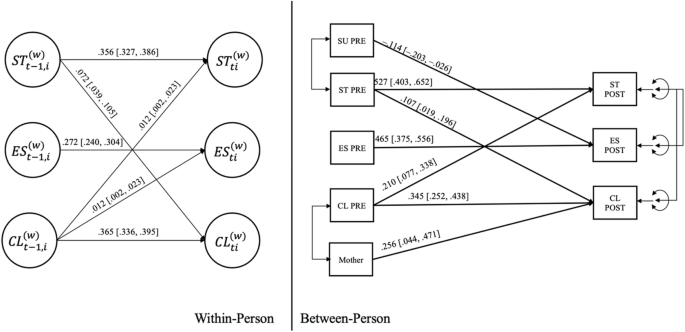
The Christmas period heightens parental demands and invisible labour, yet little is known about how these processes unfold in daily life. This study used experience sampling data from 293 UK parents over 35 days to examine temporal associations between cognitive labour, emotion suppression, and subjective stress across the holiday season. Dynamic Structural Equation Modelling revealed strong autoregressive stability for all constructs and reciprocal moment-to-moment links between cognitive labour and stress, indicating a self-reinforcing cycle.
Cognitive labour and stress also predicted subsequent emotion suppression, suggesting that emotion suppression operates as a situational coping response to mental and stress overload. At the between-person level, social support reduced emotion suppression but did not buffer stress or cognitive labour. Gender differences emerged only for cognitive labour, with mothers reporting higher levels than fathers.
Findings highlight the dynamic interplay between invisible labour and stress and underscore the psychological strains parents face during the holidays. Santa Claus is coming to town—but in the meantime, Mrs. Claus has to make the magic of Christmas happen by organising activities, buying presents, managing the household and childcare, and providing emotional support.
Household labour is commonly divided into physical, cognitive and emotional labour1,2, and its division between parents is a common source of relationship strain and personal stress. In Western countries, the Christmas period is a prime example of a time period during which household labour is doubly exacerbated: firstly, special occasions like holidays are tied to cultural expectations involving household labour. Secondly, cultural holidays like Christmas typically come with a period of school holidays, meaning the daily routines, including out-of-home childcare is disrupted.
During this period, parents are often expected to organise multiple family gatherings, coordinate travel plans to grandparents or other extended family, purchase and wrap gifts, prepare traditional meals, maintain family traditions such as decorating the Christmas tree, and manage children’s expectations surrounding the holiday season. These obligations frequently require substantial cognitive planning and emotional regulation, such as concealing stress, frustration or interpersonal tensions while maintaining a festive and positive atmosphere for children and extended family members. Parenting involves multiple forms of labour, ranging from the visible tasks of childcare and housework to less tangible but equally demanding forms of invisible labour3.
Among these, cognitive labour comprises the constant anticipation and coordination of tasks, from scheduling medical appointments to ensuring holiday preparations run smoothly. Its unbounded and never-ending character means that it intrudes into rest and leisure, contributing to chronic stress and reduced psychological well-being. However, these effects are not evenly distributed as mothers typically shoulder a disproportionate share of invisible labour3, while contextual factors such as socio-economic status (SES), single parenthood, and levels of social support further shape stress outcomes4,5,6.
Extract — continue reading at the source.


