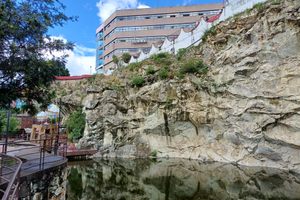
All Mexico Oaxaca Parque Ciudad de las Canteras (Quarry City Park) Rock extracted from this former quarry is responsible for Oaxaca's nickname of "Green Antequera." The flooded quarry makes for a nice reflecting pool. linkogecko / Atlas Obscura User The flooding of the quarries have lead to plenty of lakes with fish in them. linkogecko / Atlas Obscura User Sidewalk in Oaxaca’s Centro, paved with green cantera stone that might’ve come from the former quarry. linkogecko / Atlas Obscura User Being below street-level, it’s easy to get great views of the park. linkogecko / Atlas Obscura User Cempasúchil, the Day of the Dead flower. linkogecko / Atlas Obscura User Holds for climbing are a perfect fit for the quarry walls. linkogecko / Atlas Obscura User Raised walkway from which to appreciate the park. linkogecko / Atlas Obscura User Green cantera sculpture at the top of one of the quarry walls. linkogecko / Atlas Obscura User The flooded quarry makes for a nice reflecting pool. linkogecko / Atlas Obscura User The flooding of the quarries have lead to plenty of lakes with fish in them. linkogecko / Atlas Obscura User Sidewalk in Oaxaca’s Centro, paved with green cantera stone that might’ve come from the former quarry. linkogecko / Atlas Obscura User Being below street-level, it’s easy to get great views of the park. linkogecko / Atlas Obscura User Cempasúchil, the Day of the Dead flower. linkogecko / Atlas Obscura User Holds for climbing are a perfect fit for the quarry walls. linkogecko / Atlas Obscura User Raised walkway from which to appreciate the park. linkogecko / Atlas Obscura User Green cantera sculpture at the top of one of the quarry walls. linkogecko / Atlas Obscura User The flooded quarry makes for a nice reflecting pool. linkogecko / Atlas Obscura User The flooding of the quarries have lead to plenty of lakes with fish in them. linkogecko / Atlas Obscura User Sidewalk in Oaxaca’s Centro, paved with green cantera stone that might’ve come from the former quarry. linkogecko / Atlas Obscura User Being below street-level, it’s easy to get great views of the park. linkogecko / Atlas Obscura User Cempasúchil, the Day of the Dead flower. linkogecko / Atlas Obscura User Holds for climbing are a perfect fit for the quarry walls. linkogecko / Atlas Obscura User Raised walkway from which to appreciate the park. linkogecko / Atlas Obscura User Green cantera sculpture at the top of one of the quarry walls. linkogecko / Atlas Obscura User The flooded quarry makes for a nice reflecting pool. linkogecko / Atlas Obscura User The flooded quarry makes for a nice reflecting pool. linkogecko / Atlas Obscura User The flooding of the quarries have lead to plenty of lakes with fish in them. linkogecko / Atlas Obscura User Sidewalk in Oaxaca’s Centro, paved with green cantera stone that might’ve come from the former quarry. linkogecko / Atlas Obscura User Being below street-level, it’s easy to get great views of the park. linkogecko / Atlas Obscura User Cempasúchil, the Day of the Dead flower. linkogecko / Atlas Obscura User Holds for climbing are a perfect fit for the quarry walls. linkogecko / Atlas Obscura User Raised walkway from which to appreciate the park. linkogecko / Atlas Obscura User Green cantera sculpture at the top of one of the quarry walls. linkogecko / Atlas Obscura User The nickname "Green Antequera" for the Mexican city of Oaxaca de Juárez might seem strange at first: is it related to the vegetation of the valley it sits in and the mountains that surround it during the wet season? Walking in its historical center, though, the "green" part becomes clearer as this is the color of the rock that forms many of the buildings here, and even the sidewalks. This rock is known as "cantera", which is also the Spanish word for "quarry".
The Antequera part comes from a city in Spain that was named Antikaria by the Romans and with time became the modern name. What is less clear, however, is where its connection to Oaxaca comes from, although some believe that one of the first rulers of the city during colonial times was from Antequera and thus named this new city in honor of his homeland. The green cantera stone that defines most of the city's colonial architecture came from nearby quarries, with this having been one of the main ones.
In 1988, the long-abandoned quarry was opened up to the public as a park. The pits that had been dug out to mine the stone are now ponds that reflect the impressive green rock walls, some with holds for climbing. Since then, the park has continued to grow and become more accessible, with other features like a stage and seats set into the rock.
Get more unusual and extraordinary places each week with the Atlas Obscura Places newsletter. Your newsletter subscriptions with us are subject to Atlas Obscura's Privacy Policy and Terms of Use. Abandoned limestone quarry from the 19th century, now a man-made canyon reclaimed by nature.
Národní památník odposlechu (National Interception Memorial) This trio of reliefs—an ear, a mouth, and a pair of eyes—carved into the walls of flooded quarries is a monument to spying. An outdoor gallery of sculptures chiseled from a unique stone. An old quarry transformed into a recreational and cultural space.
The ancient Greeks abandoned this quarry to escape Hannibal's devastating invasion. This rocky outcrop served as a quarry for some of the bluestones that sit at the center of Stonehenge. Every September, international competitors flock to the flooded quarries of a tiny Scottish island.
Extract — continue reading at the source.


/https://tf-cmsv2-smithsonianmag-media.s3.amazonaws.com/filer_public/d6/34/d6341e1c-dae8-4784-ad3f-1d375b2dbfb4/gettyimages-2281722380.jpg)
/https://tf-cmsv2-smithsonianmag-media.s3.amazonaws.com/filer_public/06/54/0654ce82-61a8-48c6-aaa0-3474319a638f/sunset-over-bolotana-1536x1024.png)
