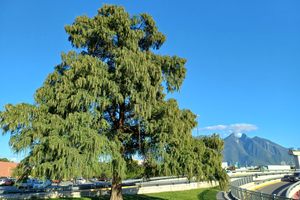
This great tree was gifted to Monterrey in 1996, the 400th anniversary of the city's foundation. The ahuehuete and Cerro de la Silla (Saddle Hill). linkogecko / Atlas Obscura User The ahuehuete and Rufino Tamayo’s “Homage to the Sun”. linkogecko / Atlas Obscura User The ahuehuete and Cerro de la Silla (Saddle Hill). linkogecko / Atlas Obscura User The ahuehuete and Rufino Tamayo’s “Homage to the Sun”. linkogecko / Atlas Obscura User The ahuehuete and Cerro de la Silla (Saddle Hill). linkogecko / Atlas Obscura User The ahuehuete and Rufino Tamayo’s “Homage to the Sun”. linkogecko / Atlas Obscura User The ahuehuete and Cerro de la Silla (Saddle Hill). linkogecko / Atlas Obscura User The ahuehuete and Cerro de la Silla (Saddle Hill). linkogecko / Atlas Obscura User The ahuehuete and Rufino Tamayo’s “Homage to the Sun”. linkogecko / Atlas Obscura User On 20 September 1596, Spanish colonist Don Diego de Montemayor founded the city of Nuestra Señora (Our Lady) of Monterrey, in honor of Gaspar de Zúñiga y Acevedo, Viceroy of Mexico at the time and who was also the Count of Monterrey. The settlement was intended to become the capital of the "New Kingdom of León" after the Spanish region.
To date, the city has come to be known simply as Monterrey and it remains the capital of what is now the Mexican state of Nuevo León, it also anchors what in the early 2020s became the country's second most-populated metropolitan area (with Metro Mexico City at a very distant first place). The 400th anniversary of this foundation in 1996 was celebrated with plenty of events, many of which were headed by the then Governor of Nuevo León Benjamín Clariond and Monterrey Mayor Jesús Hinojosa Tijerina, and which left a legacy well beyond that period. An example is a time capsule intended to be opened in 2046 (the 450th anniversary), as well as the living legacy represented by the Centennial Ahuehuete.
The dedication plaque near this specimen of Taxodium mucronatum (which has many other common names including Montezuma cypress in English and sabino in Spanish) states that it was gifted to the city in January of 1996 by Carlos Alanís Von Der Meden and family. Alanís was at one point the CEO of Grupo Vivero Imperial, considered as Mexico's largest grower of urban trees, as of 2022 he was president of the Mexican Arboriculture Society, which makes sense of his gifting of a specimen of "Mexico's national tree" on such an important occasion. Get more unusual and extraordinary places each week with the Atlas Obscura Places newsletter.
Your newsletter subscriptions with us are subject to Atlas Obscura's Privacy Policy and Terms of Use. Being located on a public garden, the ahuehuete is visible at all times. This plot of old-growth forest is the largest surviving remnant of New York City's original woodland.
Twenty-three trees, each paired with a basalt stone, line a street in Chelsea, continuing an urban project started by German Fluxus artist Joseph Beuys. A hurricane-stricken oak tree has been reborn as a beautiful chainsaw artwork. Discover the unique history of Durham from the 14th century to the present day.
A bare tree in Riga’s Esplanāde is transformed into an extraordinary vertical neighbourhood by scores of colourful bird nesting boxes clustered across its trunk and branches. A live oak beside a Florida bike trail has become a shimmering, musical memorial. ## Become an Atlas Obscura Member * * * Join our community of curious explorers. Become a Member Atlas Obscura uses cookies on its websites to personalize content and ads, to provide social media features, and to analyze our traffic.View Cookie Policy When you visit any website, it may store or retrieve information on your browser, mostly in the form of cookies.
Extract — continue reading at the source.
/https://tf-cmsv2-smithsonianmag-media.s3.amazonaws.com/filer_public/9f/b3/9fb3bc09-c4b9-4bf9-a618-b7e1de91b8ae/rare-haul-of-wooden-ob-1.jpg)



/https://tf-cmsv2-smithsonianmag-media.s3.amazonaws.com/filer_public/d6/34/d6341e1c-dae8-4784-ad3f-1d375b2dbfb4/gettyimages-2281722380.jpg)