Grail, wound, spear: some of the narrative trappings of Wagner’s final opera are immediately recognisable as symbolic. Others – woman, saviour, chastity, seduction, suffering, death – are harder to pin down, lodged in the half-light between the literal and the metaphorical. Wagner’s score is his most beguilingly luminous; its critics have pored over the work’s commitment to racial purity, its misogyny, its religiosity.
The question that Evgeny Titov’s debut production for the Royal Opera poses is whether we really believe in the story Parsifal tells – the fall, the curse, the redemption through purity – and what it means if we want to. Titov’s staging explains as little as possible. In Etienne Pluss’s sets, the grail realm is an underground bunker hewn from monumental stone blocks that trundle slowly around the stage.
There are CCTV screens and a grimy washroom where Amfortas – the fallen King – is scrubbed down by Grail Knights in breathing apparatus. Costume designer Esther Bialas has the Knights in anoraks. Kundry (the virgin-whore dichotomy incarnate) wears black leathers at first, virginal white later.
In a rare moment of literal-mindedness, Titov has Parsifal arrive holding the swan he has shot, which twitches gawkily until the orchestra heralds its demise. Evil Klingsor’s kingdom is another bunker – no enchanted garden here, just a loud suit, a telephone for barking orders, more screens with wiring that curls serpentlike across the floor and cabinets displaying his treasures: an Egyptian mummy, a crown, the sacred spear. (In another of the production’s less convincing details, Parsifal breaks the “glass” to retrieve the spear with an unsatisfying plastic crunch.) We first encounter the flower maidens as a disturbing gaggle of little girls chasing around Klingsor’s lair. Their grown-up counterparts are fembots in headdresses and silver hot pants, part chorus line, part Handmaid’s Tale.
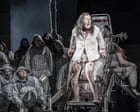
The effect is grotesque – but how could it be otherwise in 2026? Some of the stage pictures and much of the subtle lighting designs riff on the language of religious painting. Other details raise questions rather than answering them: the leather restraining straps used on Amfortas during the grail ritual, the metal gynaecological chair in which Kundry cowers.
Moments of physical tenderness stand out, shocking amid so much implied and – in Titov’s remarkable closing coup de théâtre – explicit violence. This production’s power also depends on the musical performance, which threaded beauty and emotional intensity through so much equivocation. Conductor Jakub Hrůša charted long lines through Wagner’s enormous score, taking time between some musical paragraphs and pushing precipitously onwards elsewhere.
Extract — continue reading at the source.