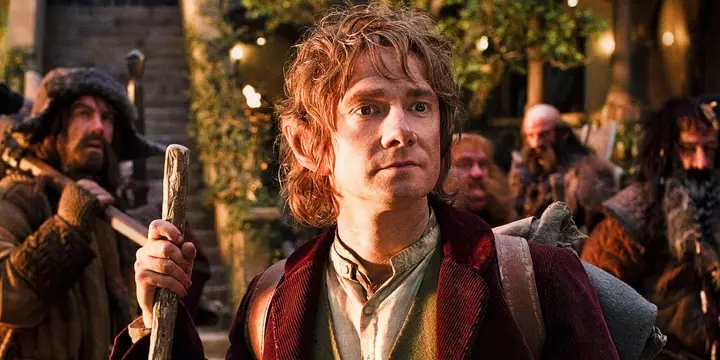
I couldn’t have been more excited for a movie adaptation of J.R.R. The story of Bilbo Baggins is my favorite book — I even prefer it to The Lord of the Rings — and I try to read it again every year. By virtue of being less ambitious, The Hobbit lets Tolkien deliver a compact narrative that makes his talent as a worldbuilder and writer shine.
That is also why, when I learned Peter Jackson would adapt The Hobbit as a trilogy of movies, I realized something was quite wrong. The results speak for themselves: The Hobbit movies are a CGI-riddled mess that, for the most part, fail to translate and portray the magic of Tolkien’s book. But blaming it all on the corporate greed that turned what could have been one great movie into a drawn-out trilogy would be too simple.
After all, Jackson and creative partner Philippa Boyens agreed to expand the originally planned two movies into three. The problem with The Hobbit movies isn’t just that they add an inordinate amount of “original” material; it’s that they forget what this story was in its conception: a bedtime fairy tale. Tolkien would call The Lord of the Rings a fairy tale, too.
For the author, “fairy stories” are those that entail the creation of a “secondary world.” They are what we today describe as “fantasy,” and Tolkien himself used that definition. Of course, the matter is much more complex, and fairy stories have more defining elements for Tolkien, who describes them in the essay On Fairy-Stories (written in 1937 and first published in 1947). However, The Hobbit’s peculiar origin makes it stand out as the most “fairy story-like” among the author’s vast production.
Between 1930 and 1931, Tolkien sat down at his desk and wrote a single line: “In a hole in the ground, there lived a hobbit.” That wasn’t the beginning of a great tale that already existed in Tolkien’s mind, just waiting to be put on paper. It was just a moment of blissful inspiration, much like Stephen King’s Dark Tower saga began with a sentence that popped into his mind: “The man in black fled across the desert, and the gunslinger followed.” Years later, Tolkien began weaving that single sentence into bedtime stories for his children. But the children, and Christopher in particular, weren’t happy about the lack of consistency between the stories.
Poor Professor Tolkien started being nagged about details like the color of Bilbo’s door or the material of Thorin’s tassel, as Christopher recounted in his introduction to The Hobbit’s 50th anniversary edition. So, Tolkien decided it was time to sit down and start writing all of this down, also spurred by the encouragement of friends and colleagues like C. Lewis, the author of the Chronicles of Narnia.
Extract — continue reading at the source.