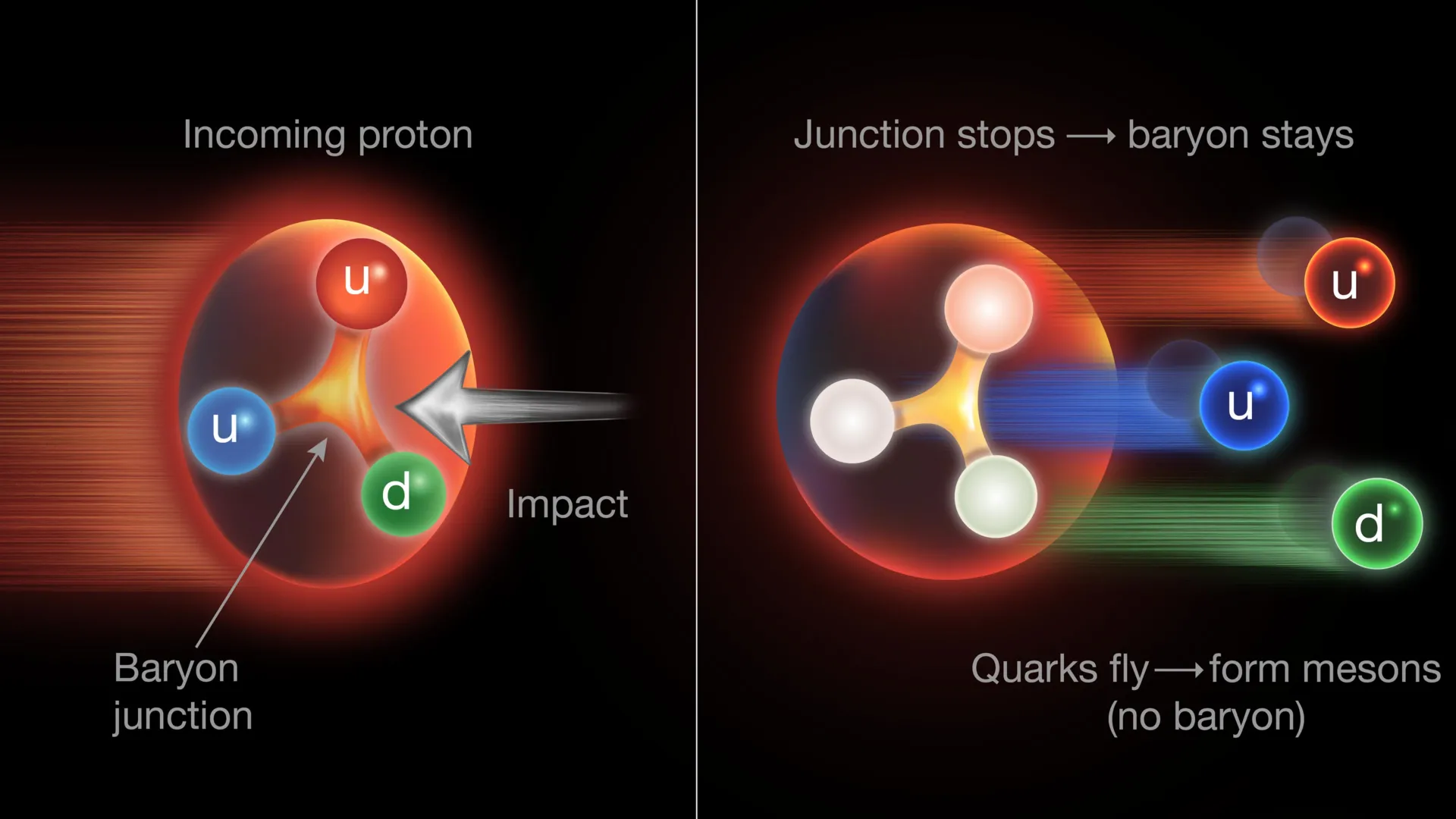
New findings from the STAR detector at the Relativistic Heavy Ion Collider (RHIC) are challenging a familiar picture of what gives protons one of their defining quantum properties. The results suggest that gluons, the particles that act as the glue holding quarks together, may play a key role in carrying and conserving baryon number. The evidence comes from high-energy particle collisions at RHIC, a U.S.
Department of Energy (DOE) Office of Science user facility for nuclear physics research that operated at DOE's Brookhaven National Laboratory from 2000 to early 2026. According to the new study, published in Science, baryon number may be associated with a Y-shaped "junction" of gluons connecting the proton's three main quarks. If confirmed, that would challenge the long-standing assumption that baryon number belongs exclusively to those quarks.
"Traditionally, scientists have assumed that each of the three main 'valence' quarks inside a proton or neutron carries one-third of the baryon number," said Zhangbu Xu, a professor at Kent State University with a joint appointment at Brookhaven Lab. Physicists first proposed the baryon junction, also called a gluon junction, in the 1970s as a way to describe how gluons connect the valence quarks inside a proton. In 1996, four years before RHIC began operating, Dmitri Kharzeev, a theoretical physicist at Stony Brook University and Brookhaven Lab, proposed that this junction might do something even more fundamental.
Rather than the valence quarks carrying baryon number, the junction itself could be responsible. The STAR collaboration has now developed a way to test that possibility using several types of collisions produced at RHIC. "Using data collected from different types of particle collisions at RHIC, our results suggest that the baryon number is not simply carried by individual quarks," Xu added.
"Our findings strongly support the idea that baryon number is more favorably carried and transported by gluons, the particles that hold quarks together, when arranged in this special configuration." Determining what actually carries baryon number matters far beyond the internal structure of a proton. In RHIC collisions, conservation of baryon number means that the total number of baryons, three-quark particles such as protons and neutrons, must remain unchanged before and after the collision. The same conservation principle also applies on the scale of the universe.
"Since the Big Bang, the number of protons and neutrons all together never changes as a function of time," said Nicole Lewis, a STAR physicist at Rice University who started this project as a postdoc at Brookhaven Lab in 2020. "The reasons for this conservation are not well understood. It's one of the mysteries of the universe, related to why we have more matter than antimatter," she said.
Extract — continue reading at the source.


