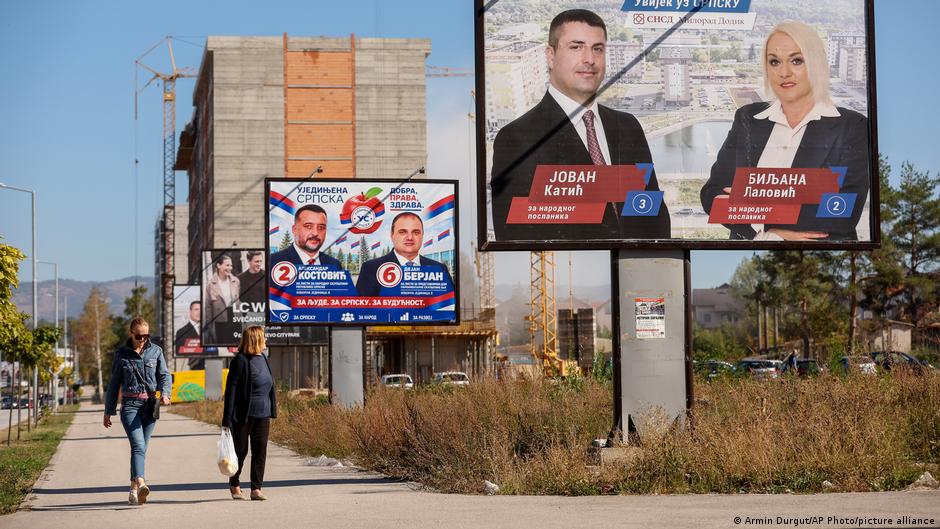
Polls closed in Bosnia and Herzegovina on Sunday evening, with around 3.4 million voters eligible to take part in the Balkan country's general election. Citizens voted for officials across multiple tiers of government, including members of the multiethnic, tripartite presidency. With counting underway, Serb nationalist Zeljka Cvijanovic, Bosniak moderate leftist Denis Becirovic and Croat nationalist Darijana Filipovic each took an early lead in for the presdential seats of their respective ethnicities.
Cvijanovic had been backed by the Republika Srpska's former secessionist leader Milorad Dodik who is barred from holding public office for six years after being convicted of defying the top international envoy overseeing the 1995 peace process. Voters also chose lawmakers for the federal parliament and the heads of institutions for the country's two largely autonomous entities — the Muslim-Croat Federation of Bosnia and Herzegovina and the Serb-run Republika Srpska. The election comes at a time when the country is struggling with a number of challenges.
There's been an economic slowdown, sluggish progress toward EU membership, and a long-drawn-out political gridlock, with the ethnically based dominant parties from the two entities repeatedly stalling decisions by the weak central government that links them. The election will see adversary ethnic parties, the Bosniak SDA, Serb SNSD and Croat HDZ BiH, pitted against multi-ethnic opposition coalitions led by the Social Democratic Party. Polls closed at 7 p.m. local time (1700 GMT), with preliminary results expected to be released late Sunday.
The economic, administrative and political responsibilities in Bosnia and Herzegovina are divided between the multiethnic central government, two semi-autonomous entities, and the self-governing neutral Brcko district. Both entities are further split into several cantons and communities. The complicated framework — divided along ethnic lines — was set up during the US-brokered 1995 Dayton Peace Accords, following the 1992-95 Bosnian war which was triggered by the breakup of Yugoslavia.
Currently in Bosnia and Herzegovina's populace, around half are Muslim Bosniaks, while 31% are Orthodox Serb and 15% are Catholic Croat. The country has been peaceful in recent years but its ethnonationalist parties have kept the divisions alive even as voters say they want to move on from the war-era rhetoric and division. In Republika Srpska, secessionist leader Milorad Dodik of the SNSD party remains the key figure despite not being on the ballot.
Dodik, the former president of the Serb-majority entity, is barred from holding public office for six years after being convicted of defying the top international envoy overseeing the 1995 peace process. Dodik-backed Savo Minic is running for the Republika Srpska's presidency. Dodik wants close ties with Serbia and Russia.
Extract — continue reading at the source.