Suicidal thoughts and behaviours (STB) span ideation (SI), attempt (SA), and death (SD), yet the factors distinguishing ideation from attempt remain poorly understood. Genome-wide studies suggest shared yet partially distinct genetic liabilities. However, few analyses have tested the differential contributions of SI-, SA-, and SD-related genetic liability across STB phenotypes, particularly in high-risk mood-disorder populations.
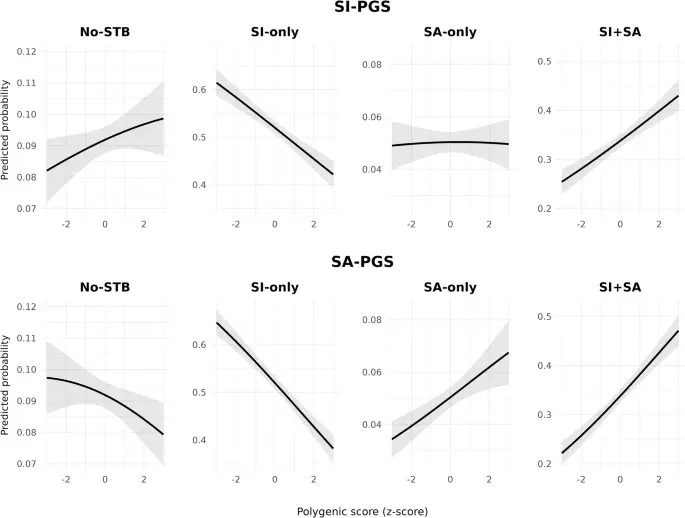
We analysed up to 17,622 participants from the Australian Genetics of Depression Study and the Australian Genetics of Bipolar Disorder study, jointly modelling polygenic scores (PGS) for SI, SA, and SD across mutually exclusive STB phenotypes using multinomial regression, alongside dimensional outcomes, age of onset, and the ideation-to-attempt transition. SI-PGS and SA-PGS showed independent and distinct associations: SI-PGS showed reduced odds of SI-only but increased odds of SI + SA, and SA-PGS robustly predicted attempt-related outcomes. Transition models captured the clearest clinical signal: SA-PGS predicted a 23% higher odds of attempt among ideators, with absolute risk differences of 9–12% between the top and bottom deciles—larger than those of the onset models (5–7%).
Predictive discrimination improved incrementally (ΔAUC ≈ 0.02–0.03; ΔC ≈ 0.01). SD-PGS showed no robust effects. Sex-stratified analyses yielded broadly consistent findings across sexes.
These findings support ideation-to-action models at the genetic level, demonstrating partially distinct polygenic liabilities for ideation and attempt. Although absolute predictive utility remains modest, these results indicate that PGS sharpen the stratification of ideators at risk of attempt, providing incremental value for future integrative risk models that combine genetics with mood disorders and environmental predictors. Suicidal thoughts and behaviours (STB) are a significant public health concern, accounting for an estimated 800,000 deaths annually worldwide [1, 2].
STB encompass suicidal ideation (SI), suicide planning (SP), suicide attempt (SA), and suicide death (SD). Clinically, prior SA is among the strongest predictors of SD, and SI is among the strongest predictors of SA [3,4,5,6,7]. Although SI is common in the general population (lifetime prevalence ≈ 9–17%) [8, 9], only a minority of ideators (2.6%-37%) ever attempt it [10].
Transitions from ideation to attempt are often rapid (e.g. 60% occur within 12 months), but some attempts emerge without reported ideation [11], highlighting the need to identify the factors that distinguish thought from action. Ideation‑to‑action theories propose that SI and SA reflect related but partially distinct liabilities [12,13,14,15], shaped by genetic and environmental influences [16, 17]. From a genetic perspective, family and twin studies estimate STB heritability at 30 to 55% [18], while genome-wide association studies (GWAS) have identified common-variant signals and estimate SNP-based heritability for SI (4.6%), SA (5.7%), and SD (16%) [19,20,21].
Extract — continue reading at the source.