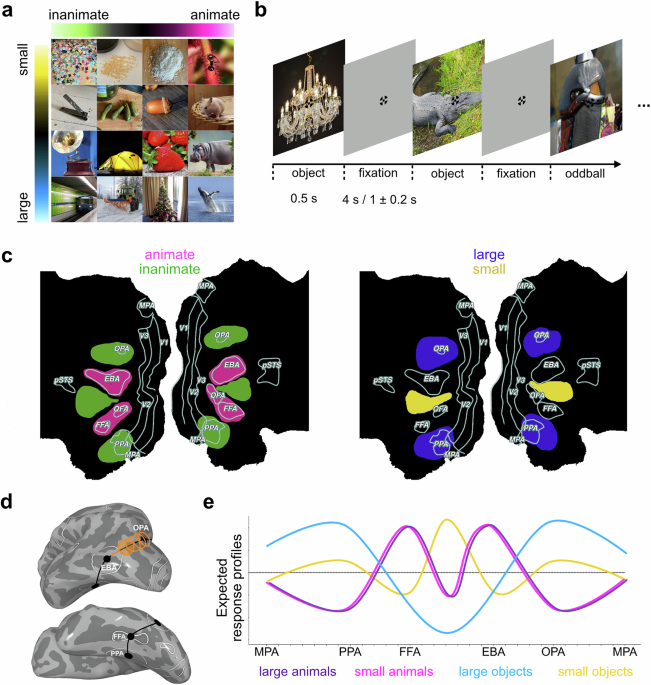
Occipitotemporal cortex (OTC) is known to support visual object processing, yet identifying general principles underlying its coarse-scale functional organization remains challenging. Previously proposed organizational dimensions, such as animacy or real-world size, may not generalize to more diverse, naturalistic stimuli and strong intercorrelations of object properties complicate determining which dimensions, if any, dominate OTC organization. We addressed these challenges through detailed analyses of the cortical topography underlying 15 object properties, using fMRI responses to thousands of natural images, focusing on animacy and size given their established prominence.
Our results confirm many characteristics of the purported animacy-size organization, but reveal distinctions that challenge dominant notions of this organization, highlighting the importance of generalizing to large-scale naturalistic data. Beyond animacy and size, many properties could alternatively serve as organizational dimensions, yet none emerges as clearly dominant throughout OTC. Together, our findings reveal a more refined animacy-size organization than previously assumed and highlight challenges of assigning individual principles to account for OTC organization.
Our brain allows us to characterize and make sense of objects according to countless different criteria. This ability not only supports the recognition of the objects around us. It also enables us to determine, among others, whether things are alive or not, whether they are big or small, whether they can move or remain static, or whether they are hard or soft.
Such distinctions help break down the complexity of the visual world for effective communication, flexible behavior, and efficient storage in long-term memory. Yet, how is it possible that we can so efficiently map the many different ways we can perceive objects to these many different facets that reflect our knowledge of the world? One possibility is that our visual system forms the foundation for an efficient mapping to behavior1, providing a basis set of mid-to-high-level features that structure our perception of the world.
At a finer spatial scale, this organization accounts for category-selective clusters in high-level visual cortex that respond specifically to ecologically relevant categories such as faces, bodies, or scenes2,3,4. At a coarser scale, these features may underlie the overall topographic organization of high-level visual cortex1,5,6,7,8. Of note, this organization does not require committing to a high-level conceptual framework, where organizational principles are abstract conceptual distinctions that are directly computed by the visual system.
Instead, these dimensions can be treated as descriptive axes that, at a coarser scale, align with these broad conceptual distinctions9,10. Adopting this view of high-level visual cortex organization, we need to answer two questions to advance our understanding of its function: First, are there dominant axes of representational space that form the foundation for this mapping between vision on the one hand and semantics, memory, and behavior on the other? And second, are these dimensions related to specific conceptual properties, or are there, instead, many possible explanations that can account for the coarse-scale organization of high-level visual cortex?
Extract — continue reading at the source.


