Addressing unhealthy behaviors requires learning and implementing healthier options. Ecologically, we rarely undergo associative learning in naive environments; our prior preferences confound the learning process. This is perhaps especially true for food, for which we have strong, diverse preferences that may undermine the associative learning policies central to dietary interventions.
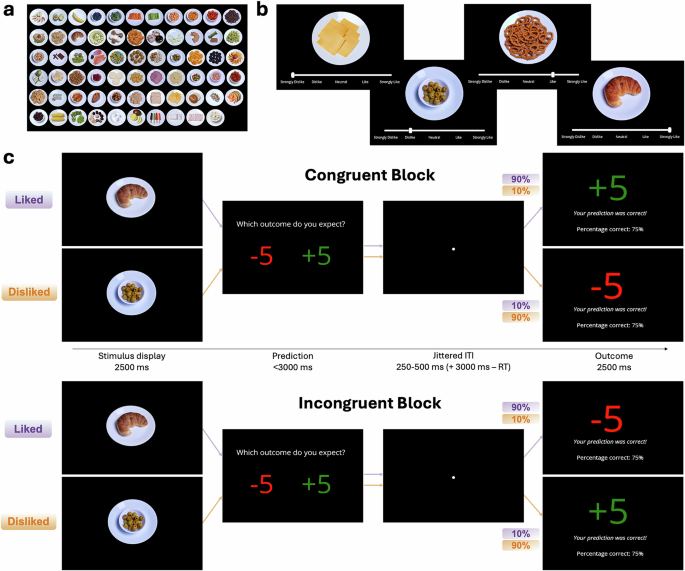
This preregistered study investigates the flexibility of updating food values using a probabilistic reversal learning task where participants predicted outcomes associated with food stimuli varying in personal preference. The task alternated between “Congruent” blocks, reinforcing pre-existing associations, and “Incongruent” blocks, reversing them. Across independent cohorts (n = 279), we found that starting condition had a surprising, lasting effect on food-value association updating, with initial reinforcement of food-value priors potentiating learning inflexibility.
Rigidity was further evident for liked food items, whereas disliked foods were adaptable to changing value associations. Additionally, associations with positive outcomes were learned more readily than negative ones, suggesting positive reinforcement may be more effective in informing food-based learning. These findings highlight the importance of reinforcement in shaping food-value associations and underscore its relevance to promoting healthier eating habits.
Food choices are driven by the subjective value of food; some individuals love olives, while others do not. Some people consider health implications when choosing food, while others base their decisions largely on taste1. While high-calorie food is considered highly palatable2, food valuation goes beyond caloric value.
For example, some strongly prefer strawberries to a calorie-dense croissant, or a croissant to a calorically similar granola bar. The subjective, or inherent, value of food items is constructed from previous reward experiences and is mechanistically interconnected with taste, texture, smell, and post-ingestive consequences of eating3,4,5,6,7. These preferences are diverse, strong, and resistant to change, yet they are often maladaptive.
Understanding how the inherent value of food may be flexibly updated is therefore of high significance for public health. Studies probing value learning typically use monetary and other rewards to assign value to inherently neutral stimuli (e.g., shapes) and examine the flexible updating of those values which were acquired in the laboratory8,9,10,11,12,13,14,15,16. Prior research has indicated that inherent values can be modified for highly preferred food items17, yet there is limited understanding of the extent and the flexibility of associative learning processes underlying such changes.
Extract — continue reading at the source.


