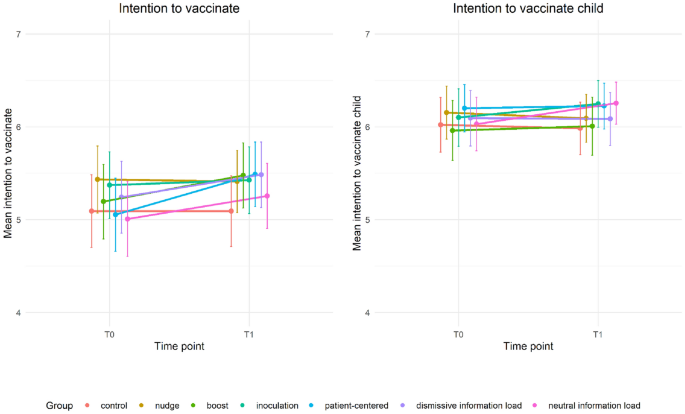
Effective vaccination communication requires evidence-based strategies, yet direct comparisons are scarce. In a longitudinal experiment (N = 901, four time points), participants were exposed to six pro-vaccination communicative texts, all centered on the concept of herd immunity to maintain consistency in information content while varying the communication style — nudge, boost, psychological inoculation (PI), patient-concerns-centred communication (PCCC), dismissive informational load (DIL), and neutral informational load (NIL) — compared against a control. We assessed the immediate and sustained, i.e., after a period of 7 and 14 days, impact on vaccination intention (personal and proxy), information-seeking habits, and vaccine-related biased reasoning.
No single communication strategy was universally superior; effectiveness depended on the decision context and pre-existing attitudes. PCCC most effectively increased immediate personal vaccination intention. Pre-existing attitudes and beliefs were strong moderators of the effect (e.g., PI and NIL were more effective for individuals reporting higher levels of vaccine conspiracy beliefs when making proxy decisions).
Critically, our findings reveal what these brief interventions can and cannot achieve: while initial gains in intention from PCCC remained stable, the impact on information-seeking habits was modest, and these brief-exposure interventions were insufficient to alter ingrained cognitive processes, such as vaccine-related biased reasoning. While brief communication can shift immediate intentions, changing how people think requires more sustained efforts. We argue that communication must be tailored to the audience and decision type, emphasizing the importance of considering patient concerns and suggesting abandoning the DIL approach given its tone and ineffectiveness.
Successful vaccination programs depend on intentional decisions rooted in a complex socio-psychological landscape1,2,3. The intention to vaccinate is a changeable and multi-determined prerequisite for the program’s success4,5. This intention is not a simple choice but a complex psychological state that integrates internal factors, such as formed attitudes, key emotions (e.g., fear and anxiety), underlying motivation, and psychological dispositions (e.g.,6).
This complex internal state is further profoundly shaped by a person’s unique experiences with vaccination (e.g.,7) and external influences, including their information-seeking habits, the fundamental level of trust in the healthcare system (e.g..8), and broader structural and social conditions (e.g.,9). The convergence of these diverse factors into an intention as a final behavioural endpoint is well captured by established theoretical frameworks, most notably the Theory of Planned Behaviour10, contemporary Integrated Behavioural Models11,12, and the specifically tailored 5 C model of vaccination antecedents9. It is this complexity that makes vaccination intention a sensitive psychological state, the nurturing of which, despite its crucial importance, has long been neglected.
This oversight largely stemmed from a prevailing assumption that the benefits of vaccination were self-evident and thus required no systematic effort to maintain public conviction2,4. However, this passive approach has become unsustainable in the contemporary communication landscape, facing a profound paradox: as vaccine science and safety oversight have reached their historical peak, public trust has eroded8. The digital media ecosystem has created a state where the public has unprecedented access to health information while facing an overwhelming wave of misinformation.
Extract — continue reading at the source.


