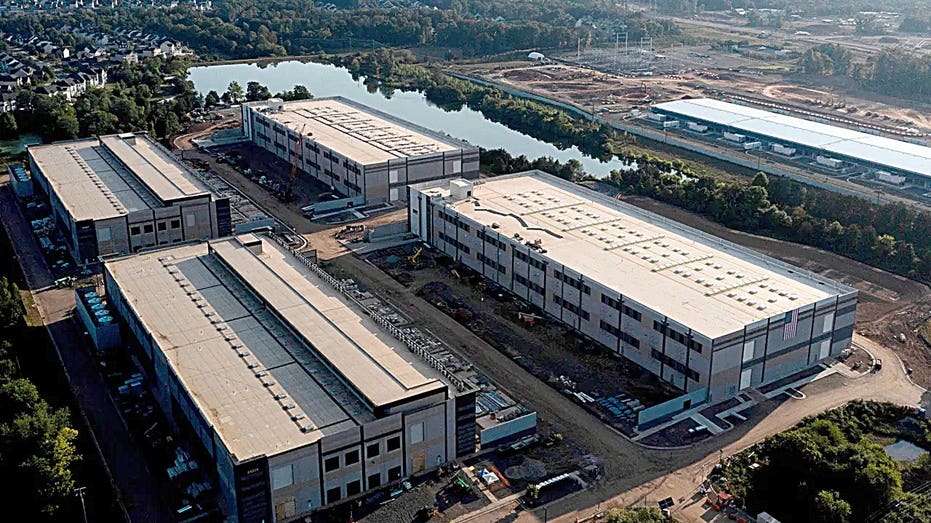
A new report from the Bitcoin Policy Institute, a think tank based in Washington, D.C., proposes that data center dividends are a model that would return part of the property tax revenue generated by AI data centers directly to households living in the communities that host the data centers, potentially providing annual payments of between about $4,500 and $8,900 per household without creating new taxes or increasing costs for developers. "Every American deserves to benefit from the AI boom," Sam Lyman, head of research at the nonprofit, told Fox News Digital. "It can't just be the developers in Silicon Valley who are becoming wealthy from this revolution.
It needs to be the Americans who are building the county infrastructure that makes these data centers possible in the first place." The proposal comes as opposition to data centers intensifies nationwide, fomented over the past year by a network of socialists and communist nonprofits funded by a tech tycoon, Neville Roy Singham, living in Shanghai, supporting the Chinese Communist Party and a "new world order" promulgated by Chinese leader Xi Jin Ping. The opposition has widened to conservatives and centrists with the report noting that Americans are now more likely to oppose a data center in their community than a nuclear power plant. In a poll earlier this year, Gallup found that 71% of Americans oppose construction of an AI data center in their area, while only 53% oppose a nearby nuclear plant.
The report says local data center moratoriums have exploded from six in 2024 to 59 last year and 294 last month. Over the past year, groups in the Singham network – including the Party for Socialism and Liberation, the People's Forum, CodePink and BreakThrough News – have opposed data centers and also Flock surveillance cameras with aggressive media campaigns, elevating China as a technological powerhouse and denigrating any developments by U.S. technology companies. "These influence actions are cognitive warfare.
Foreign actors don't need Americans to become pro-China," Rob Joyce, former director of cybersecurity at the National Security Agency, recently told Fox News Digital. "They need Americans to argue for the outcomes Beijing wants. And a free society that can't build the power and govern the advanced technology is going to wind up renting it from the adversary, read the PRC, that doesn't share its own values.
And that scares me as an American." Lyman said that the political problem is that many Americans believe technology companies are reaping the benefits of the AI boom while local communities bear the costs. The propaganda campaigns by the pro-China groups are promoting that message by describing tech executives as "oligarchs" and "imperialists." One constant message in the campaigns is "People Over Profits." "I really think that data center dividends will reverse the momentum in the data center debate, because suddenly every American who lives in these counties where data center might be built recognizes that he or she can have a material stake in the AI economy," said Lyman, a former senior adviser and speechwriter for Treasury Secretary Scott Bessent. Polling cited in the report found that 73% of Americans believe the costs of data center construction outweigh the benefits, while voters overwhelmingly believe AI will primarily enrich executives and business owners rather than workers.
Rather than creating a new tax, the proposal would redirect a portion of property tax revenue that counties already collect from data centers. "Data center dividends can ensure that rural Americans rise in the age of AI alongside the engineers developing this technology," the report notes. Under the model, counties would first continue funding schools, roads, police and other essential services.
Extract — continue reading at the source.