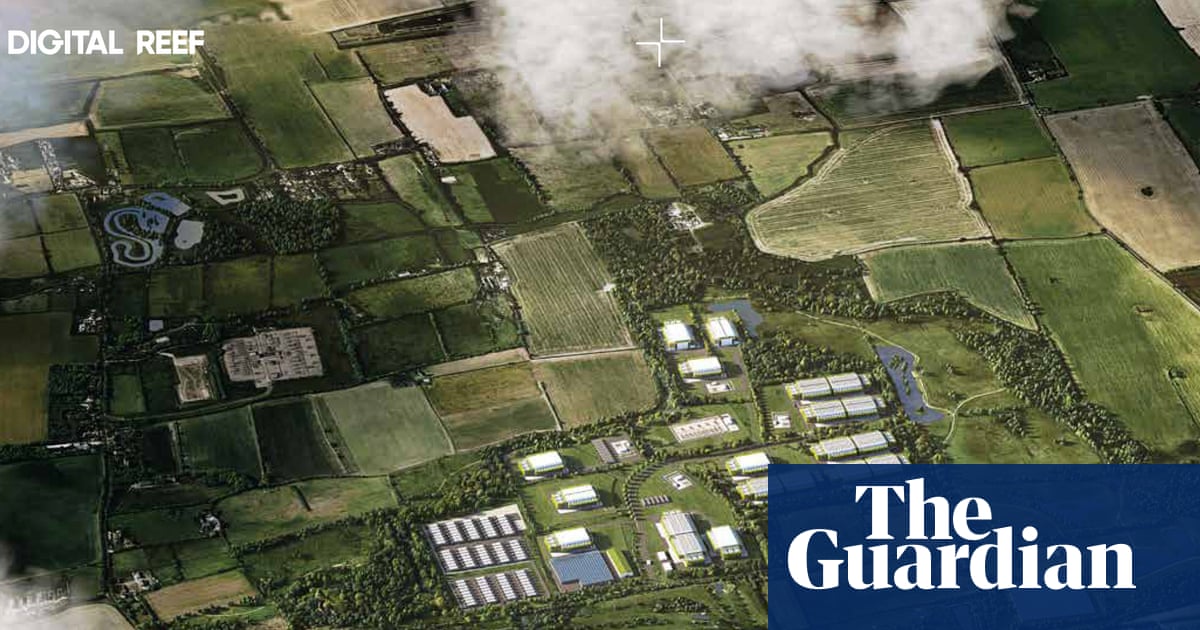
A “hyperscale” datacentre in outer London would generate more than 1m tonnes of carbon dioxide a year, equivalent to the carbon footprint of 27,000 flights from London to New York, planning documents show. The East Havering Data Centre Campus (EHDCC) in north Ockendon would be one of the largest datacentres in Europe if approved by Havering council, using 218 hectares of green belt to run servers and data storage systems for AI and cloud computing. Its developer, Digital Reef, has described the scheme as “a unique opportunity to create a sustainable datacentre campus of the future”.
But in the planning application, Digital Reef says the £14.7bn project “does not align with a science-based 1.5C compatible trajectory and achieving net zero by 2050”. Documents estimate the development would generate more than 72m tonnes of carbon dioxide equivalent (CO₂e) over its projected 60-year lifespan – 1.2m tonnes annually once fully operational. Guardian analysis of planning documents for the dozens of proposed datacentres in the UK shows that the EHDCC has the highest projected carbon emissions disclosed by a developer.
Donald Campbell, advocacy director at the tech justice nonprofit Foxglove, said the EHDCC’s projected emissions were “staggering”. Digital Reef said in its proposal that at a “likely” 50% load, the campus would consume 2.65bn kWh per year of electricity, equivalent to the demand of more than 1m UK households. The campus would be powered primarily by a huge 600MVA connection to the National Grid via the nearby Warley substation.
Because the existing site does not have sufficient capacity, major upgrades are planned, including a new 400kV National Grid substation and a new 132kV UK Power Networks facility on adjacent land, with the full connection expected by 2033. The 1.2m tonnes of CO₂e the EHDCC expects to emit would amount to 26,795 long-haul flights from London Heathrow to New York’s John F Kennedy international airport, according to the UN’s International Civil Aviation Organization’s carbon calculator. North Ockendon Residents Association said the development would be a “massacre” of green belt land.
The scale of datacentre emissions raises questions over how Britain’s rapid expansion of AI infrastructure can be reconciled with the government’s legally binding climate targets. The government designated datacentres as “critical national infrastructure” in 2024, putting the tech developments on an equal footing with water, energy and emergency services systems. By early 2025, the government estimated datacentres used 2.5% of the UK’s electricity, but predicted this would increase fourfold by 2030.
In January, planning legislation was amended so datacentre developers were able to apply as nationally significant infrastructure projects, meaning they were able to largely bypass the local authority planning procedure and seek approval directly from government. Neso, Britain’s grid operator, has warned MPs that datacentre developers have requested 72.8GW of electricity connections by 2039 – a “huge step change for the sector” and nearly 60% more than the UK’s peak power demand last year – in a surge driven by the race to build AI and hyperscale infrastructure. The government said last year the now disbanded department for science, innovation and technology (DSIT) would produce a national policy statement for the sector, but it has not yet been published.
Extract — continue reading at the source.