This mixed-methods study investigates the prevalence, attitudes, psychological predictors, and reasons for perceived effectiveness of traditional and alternative medicine in Peru. A representative national sample (N = 805) reported their experiences with 16 unconventional medical techniques, alongside psychometric measures of pseudoscientific beliefs, ideological traditionalism, and trust in the medical profession. Traditional medicine was more widely used, while alternative medicine elicited more favorable attitudinal responses.
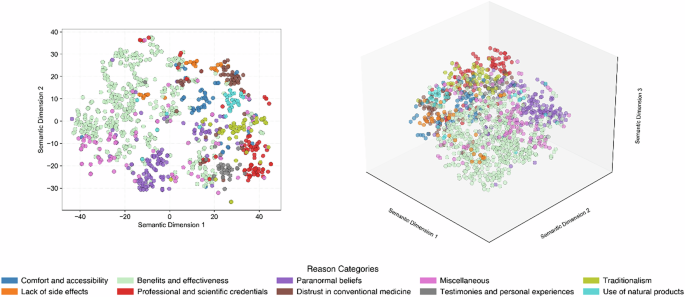
Pseudoscientific beliefs predicted greater endorsement of both modalities, with traditionalism specifically linked to traditional medicine. To enrich the psychometric findings, we applied natural language processing techniques to 2716 reasons for perceived effectiveness extracted from spontaneous open-ended responses, revealing distinct rhetorical patterns: alternative medicine was more often justified through pseudoscientific and biomedical-sounding arguments, whereas traditional medicine drew on cultural, spiritual, and experiential narratives. Network and co-occurrence analyses confirmed that both modalities follow distinctive general combinatory logics of justification.
However, subgroups mixing traditional and alternative medicine also emerged, such as spiritually oriented practices and techniques pivoting traditionalist conceptions. These findings reflect the interplay between global health discourses and local belief systems. Overall, this study highlights the value of integrating cultural and linguistic analyses to understand public engagement with unconventional health practices.
Even though the prevalence of health interventions presented as therapeutic without adequate scientific evidence of clinical effectiveness is substantial in developed countries, their incidence in developing countries such as Peru tends to be even higher (Ernst, 2022). This heightened prevalence reflects multiple structural and cultural factors, including the general educational level of the population, the influence of mass media, the strong impact of local traditions and belief systems, and limited access to conventional medicines and treatments (Mejía Gálvez et al., 2017; Santiváñez-Acosta et al., 2020). Unconventional medical techniques are usually grouped into two broad categories.
On the one hand, alternative medicine—typically of foreign origin in the Peruvian context—is defined by the World Health Organization (2019) as “a broad set of healthcare practices that are not part of that country’s own traditional or conventional medicine and are not fully integrated into the dominant healthcare system,” encompassing techniques such as homeopathy, acupuncture, energy and crystal healing, reflexology, magnet therapy, or anthroposophic medicine. On the other hand, traditional medicine is defined by the World Health Organization (2019) as “the sum total of knowledge, skills and practices based on the theories, beliefs and experiences indigenous to different cultures, whether explainable or not, used in the maintenance of health as well as in the prevention, diagnosis, improvement or treatment of physical and mental illness.” In Peru, traditional medical practices include egg cleanse, alum rub, guinea pig rub, and coca payment, which are deeply rooted in local cosmologies and cultural heritage. Although this distinction is analytically useful, the boundary between traditional and alternative medicine is not always clear-cut, as some techniques occupy hybrid positions and draw on overlapping repertoires of justification.
The use of traditional and alternative medicine is a relevant issue for clinical practice due to its associated risks (Niggemann and Grüber, 2003; Wardle and Adams, 2014), and the spread of CAM-related misinformation during events such as the COVID-19 pandemic (Recuero et al., 2021). Despite these risks, interventions originating outside conventional medicine are often integrated into or accepted within mainstream healthcare (Fasce et al., 2023; Stussman et al., 2022). In a comprehensive systematic review, Tangkiatkumjai et al. (2020) described a wide range of reasons for using unconventional treatments, including expectations of health benefits, dissatisfaction with conventional medicine, and perceived safety.
Extract — continue reading at the source.