1941: a bomb changed how she spoke, and her neighbours took her for German
When Oslo was bombed, shrapnel struck a thirty-year-old woman called Astrid. When she learned to speak again, she sounded German. She was not speaking any foreign language — the accent was being created inside the people listening to her.
On 6 September 1941, German aircraft were bombing Oslo. Shrapnel struck the left side of the head of a thirty-year-old woman named Astrid. She lost consciousness; when she came round, the right side of her body was paralysed and she could not speak.
Over months her speech returned. It returned differently. When Norwegians listened to her, they heard a German accent.
Consider the time and place: 1941, Norway under German occupation. The hardest part of the case was not medical but social. A woman injured by a German bomb had come to sound German. The neurologist Monrad-Krohn, who documented the case in 1947, recorded that she was treated as a foreigner by those around her.
The condition now has a name: foreign accent syndrome. The number of cases described in the world literature remains small — dozens rather than hundreds.
The mechanism is the interesting part, because the name misleads.
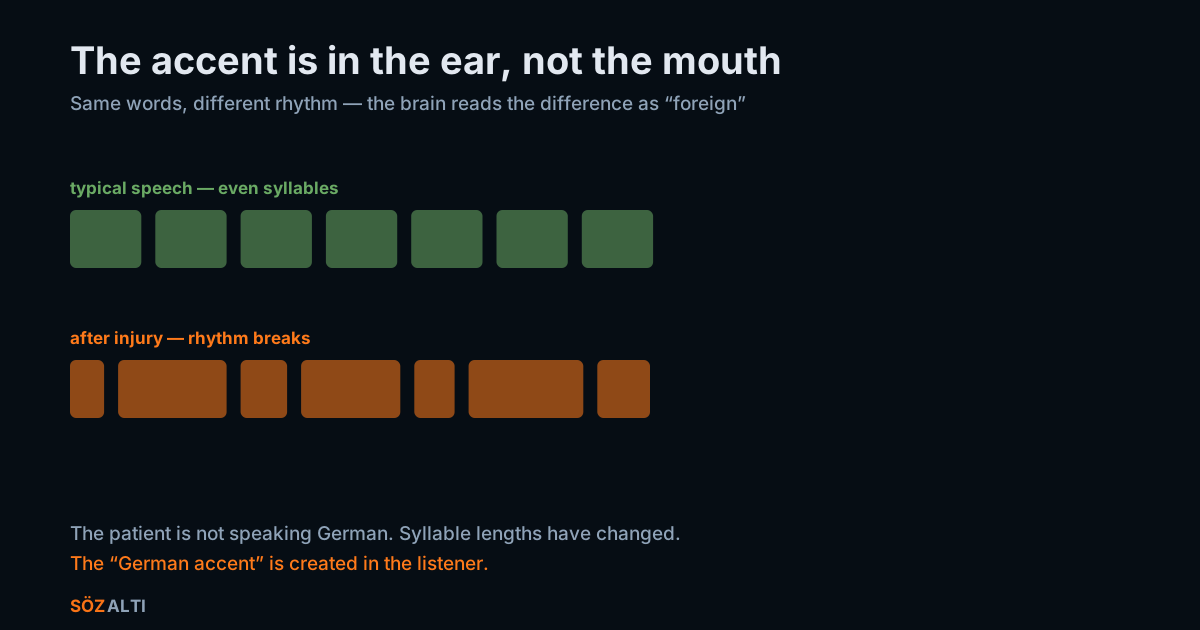
These patients are not learning a foreign language. The injury disrupts the prosody of speech — the length of syllables, the rise and fall of pitch, where stress lands. The words are the same words, the grammar holds, the vocabulary does not change. Only the rhythm changes.
Then the listener's brain does the rest. A human brain will not leave an unfamiliar rhythm unlabelled; it reaches for the nearest category it knows. To a Norwegian ear, broken Norwegian rhythm sounds like German. In another country the same patient might be heard as French, or Slavic — because the decision is made in the listener, not the speaker.
So the accent is not in the patient's mouth. It is manufactured in the listener's head. The patient simply speaks with a different rhythm; it is the other party who supplies the word 'foreign'.
This points at something general about accents. We think of an accent as a property of the person speaking. It is really a comparison — it exists only relative to somebody's norm. You cannot hear your own, because in your own head you are the norm.
What happened to Astrid is the sharpest possible version of that. Overnight, without travelling anywhere or learning anything, a woman became a foreigner in her own city. What changed was not her language. It was the ears of the people listening.
This subject was picked out and saved to this site's wiki by its readers years ago. It was a good choice.