1962: one man said no, and there was no nuclear war
The thirteenth day of the Cuban Missile Crisis. In 50-degree heat, aboard a Soviet submarine that has been out of contact with Moscow for two days, the captain orders a nuclear torpedo fired. Three men must agree. Two do. The third is named Vasili Arkhipov.
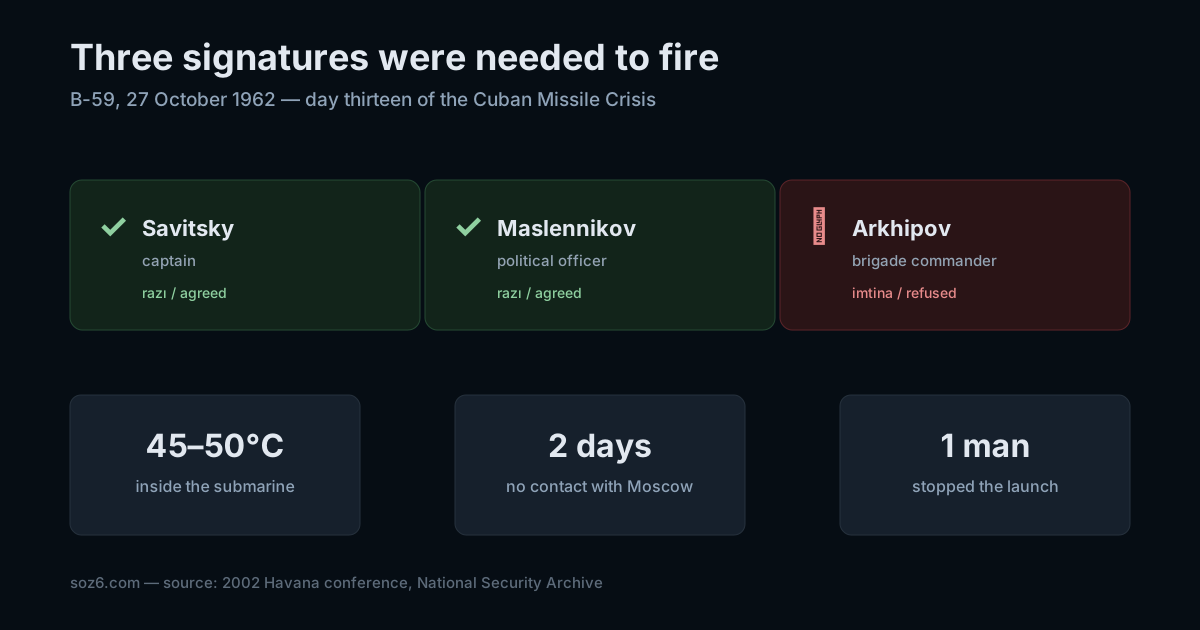
27 October 1962. The thirteenth day of the Cuban Missile Crisis. Off the coast of Cuba, underwater, a Soviet submarine designated B-59 has spent four days trying to shake off the United States Navy.
Conditions inside are at the edge of what a body can take. The air conditioning has failed and the temperature has climbed to 45–50°C. Carbon dioxide has built up to the point where men are passing out. Water is rationed to one glass a day. The batteries are running down.
Worst of all: the submarine's radio has been unable to reach Moscow for two days. The crew does not know whether the war has already started.
On the surface, American ships are dropping practice depth charges to force the submarine up. To the Americans this is a signal meaning "surface". To a crew sealed in the dark with no news for two days, it is explosions — and explosions mean war.
There was something aboard B-59 the Americans did not know about: the submarine carried a nuclear torpedo, a weapon comparable in yield to the bomb dropped on Hiroshima.
The captain, Valentin Savitsky, gave the order to fire it. His words are on the record: "We're going to blast them now! We will die, but we will sink them all — we will not disgrace our navy."
Normally, launching that torpedo required two men to agree: the captain and the political officer. The political officer, Ivan Maslennikov, agreed.
But B-59 was not an ordinary boat. It was the flotilla's command submarine, and the brigade commander was aboard. Which meant that on that day, on that particular submarine, launching required not two signatures but three.
The third man was Vasili Arkhipov.
He refused.
Arkhipov had the standing to refuse because he held rank equal to the captain's. His word carried weight because a year earlier, in 1961, he had been aboard the submarine K-19 during a reactor accident and had survived the radiation. The crew knew exactly who was talking.
The argument was long and bitter. Arkhipov held his position: the charges were a signal, not an attack; the boat should surface and re-establish contact with Moscow. Eventually the captain backed down. B-59 surfaced. The torpedo was never fired.
Consider what the alternative looked like. A nuclear detonation in the middle of an American fleet, dozens of ships destroyed, would have demanded a response — and the standing plans of the period meant nuclear strikes on Cuba and on the Soviet Union. After that the rest is arithmetic.
Nobody knew any of this for decades. It surfaced only in 2002, at a conference marking the crisis's fortieth anniversary, when Soviet archives were opened. Arthur Schlesinger, Kennedy's adviser and a participant at that conference, afterwards called the missile crisis "the most dangerous moment in human history". Arkhipov himself had died in 1998 — by the time the world learned what he had done, he had been dead four years.
There is no statue of him. No film was made. Few people know the name.
But on 27 October 1962, in 50-degree heat, inside an airless steel tube, cut off from the world for two days, one man said no — and the world we live in is built on top of that no.