The world's news day peaks at 17:00 Baku time
Thirty days, 13,733 articles, 30 outlets. We measured our own archive hour by hour, and the shape that emerged is not the world's rhythm — it is London and New York office hours.
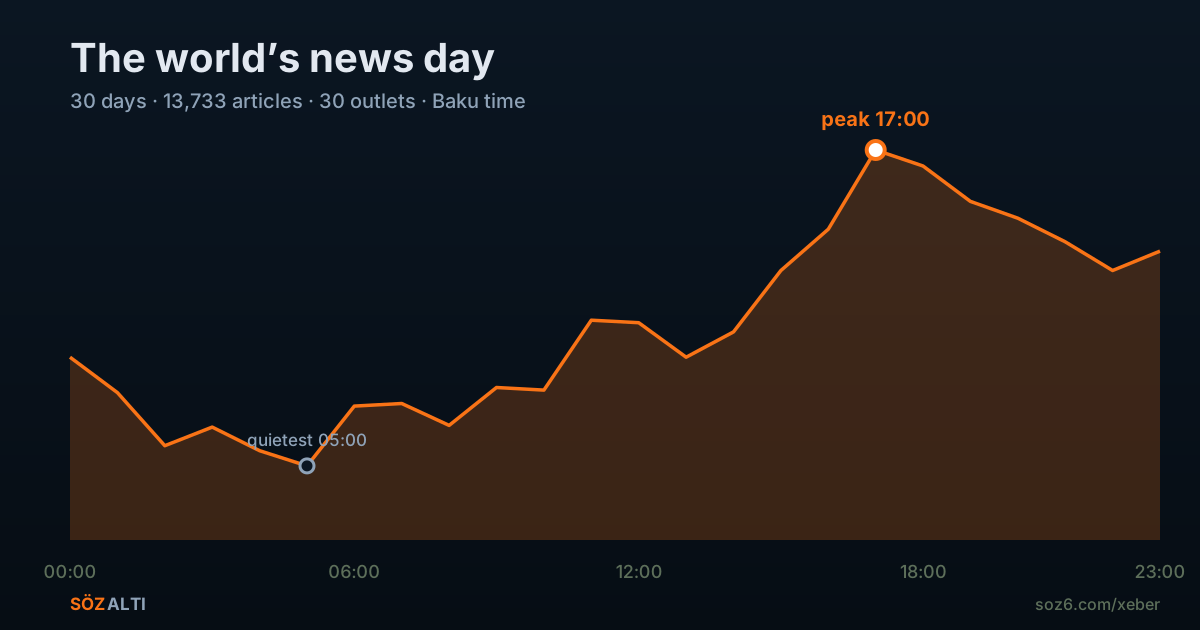
Looking at a news site, it feels like events happen at random. The day starts, something occurs, someone writes it up. But when we counted our 30-day archive hour by hour, a completely regular curve appeared — and it is not the world's curve. It belongs to a handful of cities.
The numbers: at 17:00 Baku time, 463 articles were published — the busiest hour of the day. At 05:00, just 88. A difference of 5.3x. For an Azerbaijani reader, the world is loud in the late afternoon and almost mute before dawn.
Why 17:00 specifically? Because that moment is 14:00 in London and 09:00 in New York. British newsrooms are into their second half of the day; American ones have just started. Two enormous press centres overlap, and the world's 'news peak' is created exactly there.
The quietest hour, 05:00, is the same logic inverted. That is 02:00 in London and 21:00 the previous evening in New York. Both newsrooms are asleep. Asia is awake, but most of the 30 outlets we follow are English-language Western publications, so the curve falls.
This is partly an artefact of our source list, and we are not hiding that. But it is not only us: a large share of what the world calls 'international news' comes out of those same few newsrooms. A reader in Azerbaijan, India or Brazil lives on the same clock.
The second thing we measured was the subject mix, and it speaks even more plainly. Over the last 30 days, 35.6% of articles fell under 'world' and 27.3% under finance. Nearly a third of the international news stream is markets, equities and company results.
For comparison: health is 1.0% and education 0.6%. Every day, billions of people go to a hospital or a school; in the international news feed those two subjects together occupy about one sixteenth of the space given to finance.
I do not write this as criticism — newsrooms have their own logic, and market news ages fast, so more of it gets written. I note only that the feed does not answer the question 'what is happening in the world'. It answers 'which newsrooms are at their desks right now'.
Seeing this requires holding 30 outlets in one place. Individually, the BBC sees its own schedule and so does Reuters; neither sees the combined curve. We see it because we keep them all in one table — and we think it is something a reader has a right to know too.
The practical takeaway: if you check the news at 07:00, you are reading last night's world. Today's own news will reach you in the late afternoon. That is not you being slow — the world's news day simply was not built around your time zone.