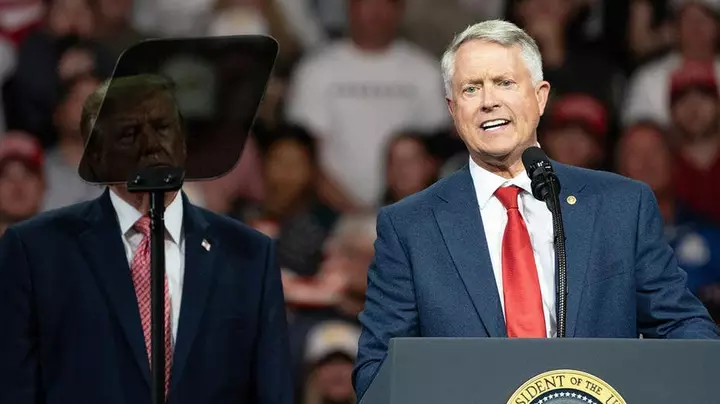
The Trump administration has given its newly created “Super Intelligence Force” broad authority to determine how the tech industry and the federal government should address threats to national security and civil liberties posed by fast-evolving artificial intelligence technology, according to a charter obtained by POLITICO. Three people familiar with discussions about the task force confirmed the document’s authenticity. The people were granted anonymity to share details that are not yet public.
The task force will identify “measures to improve the preparedness and response capability of both the government and the private sector to threats to the homeland and the American people,” the charter states. It will also produce a report on the risks of AI, focusing on “potential threats to civil liberties,” cybersecurity, standards for advanced models, and the impacts of possible overregulation. The Wall Street Journal first reported on the details of the charter.
Both Silicon Valley and Capitol Hill were caught off guard by President Donald Trump’s announcement of the task force’s creation, with four tech-sector representatives telling POLITICO the industry was not widely informed beforeTrump’s social media post. Super intelligence is Trump’s preferred term for artificial intelligence. The task force’s creation comes as major AI labs such as Anthropic and OpenAI have disclosed a spate of cybersecurity incidents related to new models with advanced hacking capabilities, sparking both industry leaders and lawmakers to call for a potential slowdown in AI development.
Director of National Intelligence Jay Clayton will lead the task force in his newly minted role as the administration’s AI czar, with Under Secretary of Defense Emil Michael, Office of Personnel Management Director Scott Kupor, and Federal Trade Commission Chairman Andrew Ferguson serving as vice chairs. Its members include administration officials across the federal government, including at the National Security Agency and the Health and Human Services Department. Senior White House officials, including Vice President JD Vance and chief of staff Susie Wiles, will also be closely involved.
Former Secretary of State Condoleezza Rice and venture capitalist David Sacks, who served as the administration’s AI czar until March, will also provide “advice” to the group on national security and technology, respectively. The task force will stand for 120 days, but its work can be extended – or functions transferred to another government agency – at Wiles’ direction, per the charter. The task force will undertake work spanning financial services, energy infrastructure, transportation, agriculture and emergency services, per the charter, and will work with the Pentagon, the Justice Department, the Homeland Security Department and the Federal Trade Commission to outline its recommendations.
The document also calls out two risk areas that have come under increased scrutiny in recent months: biosecurity and threats to the water supply. OpenAI recently threw its weight behind a slate of bills aimed at preventing AI models from exacerbating the threat of biological weapons, and rival lab Anthropic disclosed several incidents in which scientists in foreign countries used their models to research dangerous pathogens. The Trump administration also rolled out a program in August to protect vulnerable U.S. water facilities from cybersecurity threats, following a series of cyberattacks on local water systems across the country.
Extract — continue reading at the source.