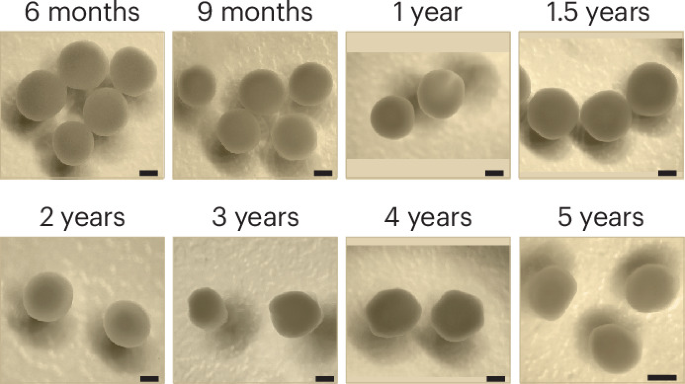
In a recent paper in Nature, Faravelli et al. report a long-term culture system in which they have cultured human cortical organoids for over five years. The team, led by Paola Arlotta at Harvard University, first established a long-term organoid time series by profiling 34 individual organoids at various time points, from 6 months to up to 5 years in culture and integrating these data with previously published data from 76 organoids profiled from 15 days to 6 months. Then, the authors used label transfer from reference datasets of endogenous human cortex to assign developmental ages to individual organoid cells.
In the next step, the team used DIALOGUE, a method for identifying gene signatures, to uncover age-related gene-expression programs in the human cortex and projected these maturation modules onto the organoid dataset. They observed a strong correlation between in vivo age-related module scores and duration of in vitro development, suggesting a gradual progression of gene-expression programs associated with maturation. This is a preview of subscription content, access via your institution Access Nature and 54 other Nature Portfolio journals Get Nature+, our best-value online-access subscription Receive 12 print issues and online access Prices may be subject to local taxes which are calculated during checkout Nature Methods https://www.nature.com/nmeth/ Mukhopadhyay, M.
Recording time via brain organoids. Nat Methods 23, 1938 (2026). https://doi.org/10.1038/s41592-026-03257-w DOI: https://doi.org/10.1038/s41592-026-03257-w
Extract — continue reading at the source.


