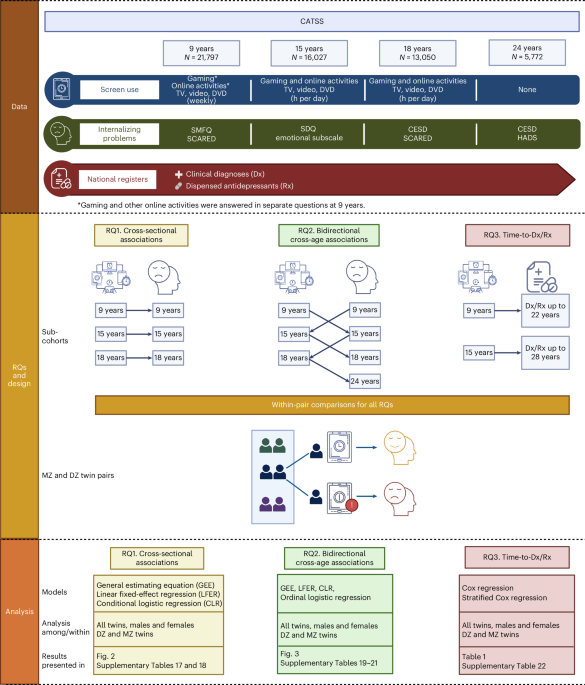
The mental health impact of increasing recreational screen use among youth has raised substantial concerns, yet questions about causality remain unresolved. Here, leveraging a co-twin control design, we examined associations between screen use and internalizing problems from childhood to early adulthood among 21,797 Swedish twins, accounting for shared familial factors. Recreational screen use was associated with increased internalizing symptoms and clinical diagnosed depression and anxiety.
However, these associations were substantially attenuated within discordant twin pairs and did not remain statistically significant after correction for multiple testing. These findings suggest that shared genetic and environmental factors partly explain the association between youth screen use and mental health. Although co-twin estimates provided limited evidence for clear causal effects, the association between heavy interactive screen use and clinical risk highlights the need to understand potential mechanisms linking digital behaviours and youth mental health.
The rapid proliferation of digital technologies has profoundly reshaped daily life, particularly for youth. The sharp rise in recreational screen use (that is, screen-based entertainment via devices such as TV, computer or mobile phone1) has raised concerns about its potential impact on youth health, especially mental health2. Public health agencies worldwide have responded by introducing guidelines aimed at limiting recreational screen time among children and adolescents to prevent negative health effects3,4,5,6,7.
However, these guidelines are primarily based on non-causal evidence; their effectiveness is thus under debate8,9,10. Rigorous investigations into causality and direction of effect are urgently needed to inform interventions on screen use among youth10. Specifically for internalizing problems such as depression and anxiety, recent systematic reviews and meta-analyses of observational studies have generally supported an association with increased recreational screen use11,12,13, particularly among teenage girls14,15.
Yet, observational studies inherently face limitations related to confounding, that is, a wide range of genetic16,17, developmental, familial environmental, social and psychosocial factors may simultaneously influence recreational screen use and internalizing problems, potentially biasing these observed associations18. Experimental designs such as randomized controlled trials (RCTs)—widely regarded as the gold standard for establishing causality—have begun to generate evidence on the causal relationship between recreational screen use and internalizing symptoms19,20,21. Nonetheless, practical constraints, for example restricting screen use in daily life (especially over extended periods), significantly limit the feasibility of conducting large-scale RCTs to explore cumulative exposure or long-term effects.
As a quasi-experimental design, twin research has long been used to strengthen causal inference22. Monozygotic (MZ) twins share their rearing environment and all inherited genetic factors, while dizygotic (DZ) twins also share their rearing environment and only (on average) half of their segregating genes. The co-twin control (or discordant twin) design, in which exposed twins are compared with their unexposed twin as matched controls, enables effective control of shared genetic and familial environmental factors typically unmeasured in observational studies23.
Extract — continue reading at the source.


