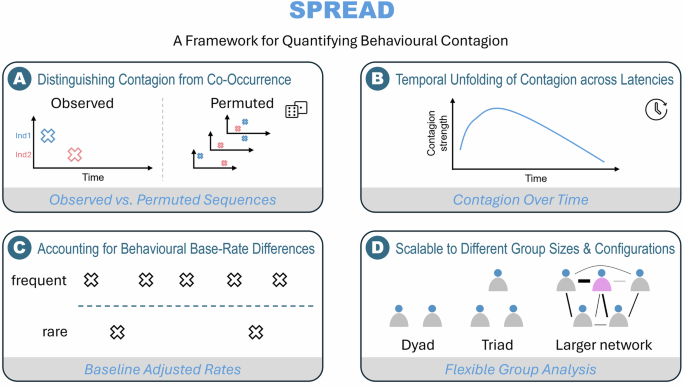
Behavioural contagion, when one individual’s behaviour increases the likelihood of similar behaviours in others, is a fundamental dimension of social interaction, yet its empirical quantification remains methodologically challenging. Distinguishing contagion from coincidental co-occurrence, resolving contagion across continuous latencies rather than within fixed windows, accounting for behavioural base rates, and incorporating social structure require integrated analytical solutions. We present SPREAD, a conceptual and statistical framework implemented as an open-source R toolbox for quantifying behavioural contagion in time-series interaction data.
SPREAD compares observed behavioural sequences with null distributions generated from permuted data that preserve individual event frequencies while disrupting inter-individual temporal alignment. The framework yields latency-resolved, base-rate corrected estimates of contagion strength that are comparable across behaviours and social configurations. We demonstrate SPREAD across two behavioural domains, laughter and eating, using human triadic data and illustrate its ability to detect contagion effects across distinct temporal dynamics.
Human behaviour is deeply shaped by the social environment in which it occurs1. One particularly striking phenomenon is behavioural contagion, referring to the spontaneous spread of behaviours from one person to another within a temporal window ranging from milliseconds to minutes. Across the literature, contagion has been conceptualised in multiple ways, ranging from reflex-like mimicry to temporally extended forms of behavioural contagion, including affective convergence2,3.
Classic examples include yawning, laughter, and smiling, rapid expressive behaviours that can be triggered almost reflexively upon observation4,5. The same contagion logic can also be applied to more temporally extended and structured behaviours such as eating, where contagion manifests in coordinated bite timing and matched food choices within social interaction6,7. Behavioural contagion is embedded in social structure.
Both social relationships and group size shape how behaviours spread, influencing not only the likelihood of transmission but also the form that contagion may take2,3. Who interacts with whom, and how many individuals are present, determine the relational pathways through which behavioural influence unfolds. From a methodological perspective, this implies that contagion should often go beyond the dyadic level and be examined within the broader relational and structural context in which behaviour occurs.
In addition, behavioural contagion is inherently dynamic: responses emerge at specific latencies and may accumulate across multiple individuals over the course of an interaction. Such temporal alignment can give rise to behavioural synchrony, reinforcing social cohesion and positive affect among group members8,9,10. This temporal perspective aligns with work in social neuroscience, particularly the second-person neuroscience framework11,12, which emphasises the importance of studying behaviour as it unfolds within ongoing, reciprocal social interactions.
Extract — continue reading at the source.


