Smart monitoring systems (SMS) are increasingly deployed in community-based care to empower older adults to live safely and independently. However, existing research largely treats monitoring as a process in which continuous data collection and real-time alerts are intended to translate into improved outcomes. What remains underexplored is how older adults experience monitoring and how it shapes their behavior over time.
In this qualitative longitudinal study, 21 older adults are accompanied from SMS installation for more than one year, with individual semi-structured interviews conducted across four data collection phases. Findings reveal that older adults actively anticipate how the system interprets their behavior, producing three responses: reactance, that is, disengaging from devices to reclaim autonomy over safety; preemptive behavior, for instance, restructuring daily routines to avoid triggering alerts constraining their autonomy and safety; and performative compliance, that is, managing behavior to satisfy caregivers rather than personal needs, leading to a loss of autonomy. These constitute autonomy-safety value tensions: a technology designed to advance both values instead produces conditions under which protecting one systematically undermines the other.
To this end, this study provides empirical insights into unintended consequences and a conceptual model explaining how value tensions emerge, with implications for practitioners and caregivers. Global populations are aging at a rapid pace, putting healthcare systems under pressure to provide dignified elderly care1,2. Institutionalized care for older adults is costly, labor-intensive, and opposed to the need for autonomous and safe aging in place, that is, maintaining independence within the familiar surroundings of one’s own home3.
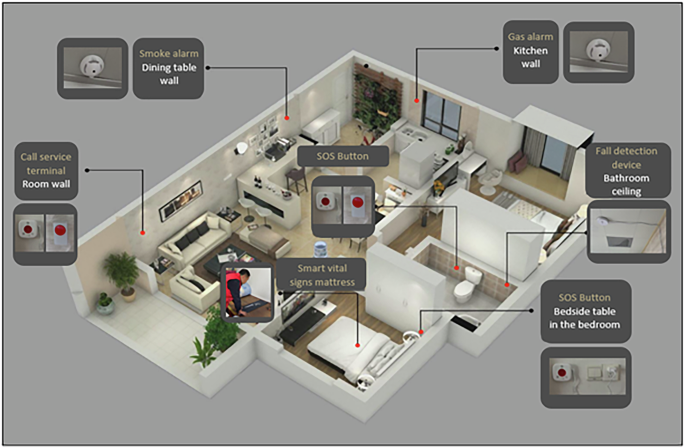
Consequently, policy makers, care providers, and technology developers have sought alternatives that follow the dual objective of empowering individual autonomy and physical safety in later life4,5. The decline in cost for digital healthcare technologies has given rise to a promising solution: smart monitoring systems (SMS)6,7. These systems leverage environmental sensor networks, including fall detection and movement sensors, smoke detectors, emergency buttons, and smart mattresses (see Fig. 1), to unobtrusively, yet continuously, monitor activities and vital signs of their users8.
By transmitting collected data to respective responders, such as professional or informal caregivers, SMS enable early detection of critical events and timely intervention9,10. Hence, these systems are increasingly installed in living environments explicitly aiming to empower older adults, for example, by ensuring that medical monitoring is provided not only in the presence of a caregiver but also during the largest parts of the time the older adult spends on their own11,12,13. Yet, this objective becomes fragile once SMS are understood not as purely technological infrastructure but as sociotechnical arrangements that actively reconfigure individual agency7,14.
For instance, fall detection sensors installed across rooms of an apartment do not merely register emergencies. They also render movement patterns continuously visible to relatives and caregivers, transforming private activity into monitored events15. This tension has been anticipated in design discourse.
Extract — continue reading at the source.


