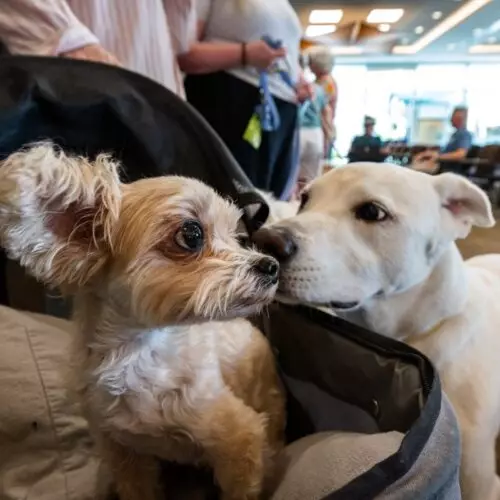
It’s a regrettable reality that there is never enough time to cover all the interesting scientific stories we come across. So every month, we highlight a handful of the best stories that nearly slipped through the cracks. October’s list includes an epigenetic mechanism for why large dogs age faster than smaller ones; physicists who trapped a single particle of antimatter for months; and invisible tattoo inks that only show up under UV light.
In many mammalian species, larger creatures tend to have longer lifespans. Mice, for instance, live an average of just two years, while some whales can last for as long as 200 years. Dogs, however, buck this pattern; larger dogs tend to age faster and die younger than smaller ones, which makes canines an ideal model for biologists to study to learn more about aging in general.
Arizona State University scientists report that these lifespan differences seem to be due to so-called “jumping genes,” according to a paper published in the journal Science. The authors used data from 864 dogs collected in the Dog Aging Project to map patterns of DNA methylation (which influences how much certain genes are turned on or off) across the entire genome. It’s part of the epigenome, whose markers can change over time in response to stress and other environmental factors.
Genetic sequences, by contrast, are largely fixed. So DNA methylation is a good chemical indicator of aging and DNA regulation. Their analysis showed that aging in dogs is linked to the decrease in the regulation provided by DNA methylation, particularly in regions where there are “jumping genes” that can move from chromosome to chromosome.
These jumps can damage DNA, causing cancer and other age-related diseases, and their activity increases with the loss of regulatory markers. The authors identified a specific class of jumping genes called LINE1s that were responsible for the different rates of aging in dogs. Giant dog breeds lost roughly 35 percent more LINE1 methylation each year compared to small breeds.
Extract — continue reading at the source.