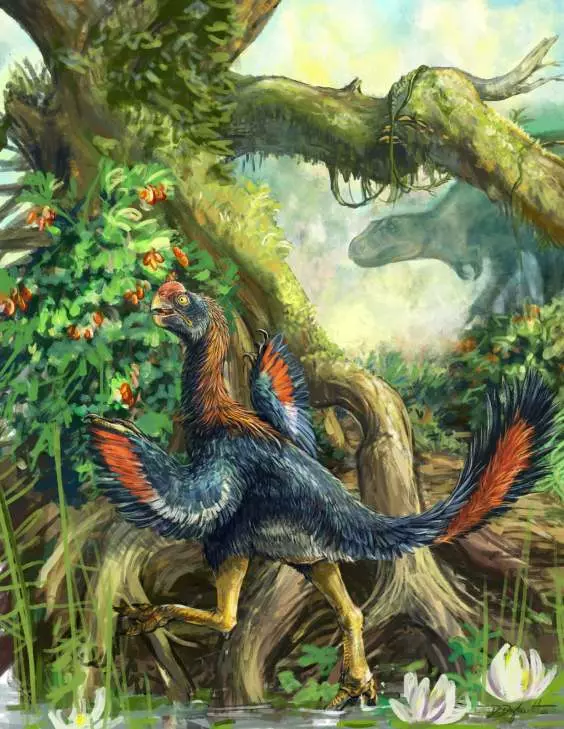
Flowering plants first evolved during this period and started taking over on land, replacing cone-bearing plants. But who was eating this newly evolved produce? While the armored ankylosaurs and duck-billed hadrosaurs may have incorporated fruit into their diets, they still mostly subsisted on leafy plants.
Now, paleontologists have unearthed a dinosaur that appears to be a specialized fruit-feeder, describing it for the first time in a study published in Nature Communications. Read more: “The Strawberry Is a Frankenfruit” The species was discovered in the famed Hell Creek Formation, a sprawling fossil-rich region covering Montana, North Dakota, and South Dakota. Its final resting place gave the species its genus name, Infernogallus, or “hell chicken.” Roughly the size of a turkey, this hell chicken was an odd duck.
According to the researchers, its musculature gave the small dino chewing mechanics that were adept at mashing up pulpy fiber. Its palatal bones (forming the roof of its mouth) arched downward, meaning certain muscles faced front-to-back and not up and down. This allowed the dinosaur to slide its beak back and forth in a chewing motion, rather than a vertical chomp.
The team says this jaw architecture is fairly rare in the animal kingdom, but present in omnivorous mammals (like humans) as well as the vulturine parrot, which eats fruit. It could also mean dinosaurs played a larger role in the evolution of fruit-bearing plants than previously thought, helping the immobile flora disperse its seeds. Subscribe to our free newsletter.
Extract — continue reading at the source.