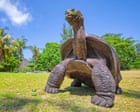
A landmark survey of the world’s largest free-roaming giant tortoise population has revealed the once endangered species is thriving. A population of Aldabra giant tortoise lives on an island in Seychelles called Aldabra Atoll. The most recent survey, led by Seychelles Islands Foundation (SIF) and the University of Exeter, revealed there were approximately 180,000 tortoises living on the island.
This is the highest figure ever recorded for the species and far exceeds the human population of Seychelles. The new figure was obtained by a team who analysed five years of tortoise counts between 2018 and 2022. It is the first update since a widely cited figure of 100,000 tortoises from the late 1990s.
Aldabra Atoll is one of only two places in the world where giant tortoises are found in the wild, with a much smaller population living in the Galápagos. Dr Frauke Fleischer-Dogley, CEO of SIF, said: “More than 180,000 giant tortoises roaming freely on our atoll is proof of what long-term commitment to conservation can achieve. In the 19th century, exploitation of the animals meant there were fewer than 1,000 Aldabra tortoises left on the island.
But a recovery programme meant the island became a strict nature reserve in 1981 and a Unesco site in 1982. Researchers are now saying it is one of the greatest conservation success stories of the Indian Ocean, with the new study confirming it. Aldabra’s climate is changing, with longer and more frequent droughts predicted to reduce the shade and food available to tortoises, while rising sea levels threaten low-lying parts of the atoll.
The study authors say invasive mammals remain a key threat including feral cats and black rats that prey on tortoise eggs and hatchlings. The planned eradication of these remaining invasive mammals, the authors say, could lift the last barriers to further growth of the population and help it withstand future climate pressures.
Extract — continue reading at the source.


