People in poverty sometimes behave in ways that perpetuate their socioeconomic condition. By one influential account, these behaviors arise from psychological effects of scarcity on attention that create greater focus toward managing scarce resources, at the cost of attention to potentially-beneficial information outside of this ‘tunnel’. Although the tunneling hypothesis has been widely discussed in academia and beyond, its direct empirical support derives primarily from a landmark study by Shah et al. (2012) in which participants played games while their access to resources was experimentally manipulated, rendering participants either ‘rich’ or ‘poor’.
Here, we present new analyses that contest the original interpretation of the data, showing that the behavioral differences between ‘rich’ and ‘poor’ participants are more parsimoniously explained by the game’s structure than by an attentional shift caused by the scarcity manipulation—a conclusion we substantiate through an additional experiment. We contextualize our findings within the literature on scarcity and attention, and highlight the need for greater clarity regarding the tunneling hypothesis itself. People living in poverty sometimes exhibit behaviors that perpetuate their socioeconomic condition, including borrowing money at exorbitant interest rates1, and failing to enroll in subsidized insurance programs2,3.
While previous accounts attributed these behaviors to personality traits4 or preference patterns5 of low-income individuals, a recent and influential account proposes that the experience of resource scarcity creates its own mindset, changing how anyone facing such conditions would think and make decisions6,7,8. The first key proposal of this scarcity theory is that the experience of scarcity induces a tax on cognitive capacities (i.e., a bandwidth tax): people are argued to experience more cognitive load when faced with scarcity9,10,11, and to consequently exhibit reduced cognitive control12,13,14. The second key proposal of scarcity theory–and the focus of the present paper–is the tunneling effect, according to which scarcity increases attention toward managing scarce resources themselves, resulting in some positive outcomes (greater focus; e.g., less susceptibility to framing effects)15, at the cost of attention to other potentially-important information, leading to some negative outcomes like the poverty-perpetuating behaviors mentioned in our opening sentence (attentional neglect; e.g., taking on payday loans due to not noticing their high interest rates).
While there is some evidence for the proposal of a bandwidth tax (for a review, see de Bruijn & Antonides)6, evidence for the positive and negative effects of tunneling primarily derives from a single, widely-cited paper published by Shah and colleagues in Science in 2012,16 which has been highly influential in academia and beyond17,18,19. Indeed, this work has shaped policy around international development and poverty alleviation20. Although several other studies have been cited as providing evidence for tunneling, these other studies have only offered partial support for the hypothesis, finding that individuals under scarcity exhibit greater focus (leading to positive outcomes including better memory for prices7, less susceptibility to framing effects15, and faster detection of words related to scarce resources)12,21,22, without demonstrating that this greater focus takes away from attention to other potentially-beneficial information (for more information, see the Discussion section).
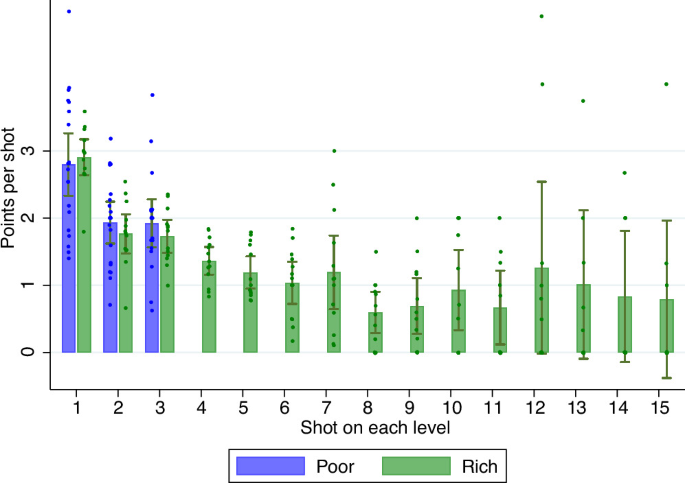
Thus, only Shah et al.16, have directly tested and substantiated the idea that scarcity makes people approach a task with a unique mindset, which leads them to focus their attention on managing their scarce resources, to the neglect of other information. In Shah et al.16, participants played lab-based games while scarcity was experimentally manipulated. Here, we re-analyze the data from a key study in this paper–the ‘Angry Blueberries’ experiment (Study 2 of the original paper)–which, according to the authors, provides a cornerstone for their account by establishing the positive and negative effects of scarcity on attention within a single study16,23.
We also reanalyze data from a large-scale replication of this experiment conducted by the same authors in 201924. Our re-analyses contest the original interpretation of the data as providing evidence of an attentional tunneling effect, and we also present additional experimental evidence from a conceptual replication study supporting our alternative interpretation. In the ‘Angry Blueberries’ game, participants shot blueberries, earning points for hitting targets (for specificities of the game, see Table 1).
Extract — continue reading at the source.