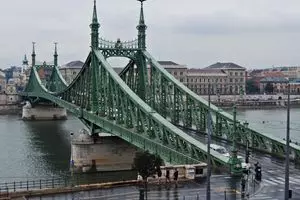
Most Popular PlacesRandom PlaceListsItinerariesAdd a PlaceDownload the App Ruins of the Ferenc József Bridge First Death Marker on the Trail of Death Hunebed D27 Grotta Tanaccia Where to See the World’s Most Famous Preserved Body Parts 6 days ago Atlas Obscura’s Guide to America’s Most Haunted Cemeteries 13 days ago The Best Haunted Hotels to Book for a Spooky Getaway 22 days ago When the water level in the Danube in central Budapest is low enough, there is a secret site telling the history of one of the most iconic bridges of the city. The Liberty Bridge replaced the destroyed Ferenc József Bridge in 1946. Felix König / CC BY 3.0 The Liberty Bridge replaced the destroyed Ferenc József Bridge in 1946.
Felix König / CC BY 3.0 Walking through Budapest, it is impossible to ignore the stunning bridges. One in particular garners the attention of tourists, the _Szabadság híd_, or Liberty Bridge. It is ornate, green, and connects two very important parts of the city — Gellert Hill and the Central Market.
It is also the only central bridge with old-timey trams regularly running across it, making it an iconic photo spot. But if you are lucky enough to find the Danube River level low enough, you can peer over the edge and see the ruins of its former self beneath the river. The Ferenc József Bridge was destroyed during the bombings of the Battle of Budapest in January 1945.
On most days, that is a history that is easily forgotten by pedestrians crossing the bridge and enamoured with the fantastic views of the city that it offers. But when the weather and the temperature along the Danube collude to make the levels low as they so often are in summer, the lost remnants of the old bridge appear close to the surface and sometimes even jut out of the water. What you're looking at is the skeleton of the bridge that was destroyed by a Soviet shell detonating German explosives left on the bridge on 16th January 1945 in what is now known as the Siege of Budapest.
Unfortunately, this is likely to become a common sight if Hungary (and the rest of Europe) continue to swelter through hot, dry summers brought on by climate change. Get more unusual and extraordinary places each week with the Atlas Obscura Places newsletter. Your newsletter subscriptions with us are subject to Atlas Obscura's Privacy Policy and Terms of Use.
From the small viewing platform on the south side of the bridge towards the Buda side, if you crane your neck over, you can see several struts poking out at the top of the water, trusses, cross-beams, and steel girders that would have allowed horse-drawn carriages to pass from Pest to Buda before the Second World War, lying flat against the riverbed. A railway bridge leading nowhere stands lonely in the middle of a meadow. Walk underneath a railway bridge over the river Reuss with just a metal grating under your feet.
Extract — continue reading at the source.