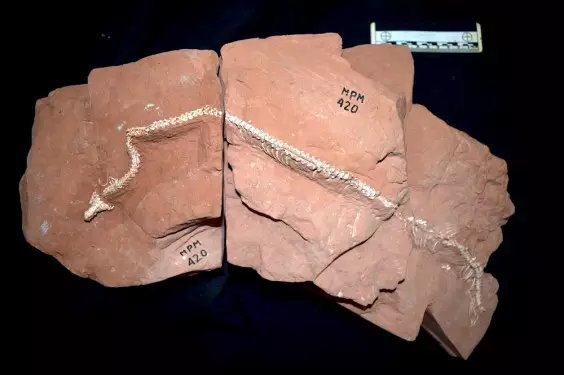
Did they evolve in the sea, underground, or on land, given that today they inhabit all those environments? Now, an exceptionally preserved Cretaceous fossil found in 2020 west of São Paulo, Brazil, sheds a bit of light on snake origins. A study recently published in the journal Nature described the fossil of a newly identified, very early snake ancestor species, Tametara mirim gen. et sp. nov., that was about the length of the bottom of a coat hanger.
Based on its skull anatomy, the authors suggested that the snake led a burrowing lifestyle. They used high-resolution micro-CT scans to map the contours of its cranium in enough detail to reconstruct its neuroanatomy, including its inner ear, cranial nerves, and brain. The 3D reconstructions revealed that the ancient snake had dense, overlapping cranial bones, a helmet-like feature found in many species of burrowing animals that protects their skulls from impact.
Tametara’s eyes likely weren’t great, based on its poorly defined optic lobes—as indicated by the fossil’s brain case—a characteristic typical of animals living in dark places. Its ears also probably functioned like those of a burrower. While the discovery of Tametara doesn’t completely resolve the matter of which habitat—subterranean or terrestrial—gave rise to modern snakes, it did show that snakes had already been around for a while, evolving along different paths, by the time Tametara burrowed in the soil about 80 million years ago.
Both Tametera and Dinilysia were extinct by the time modern snakes slithered their way onto the scene. But the two ancient species show that snakes were experimenting with lifestyles early on in the group’s evolution. Subscribe to our free newsletter.
Extract — continue reading at the source.