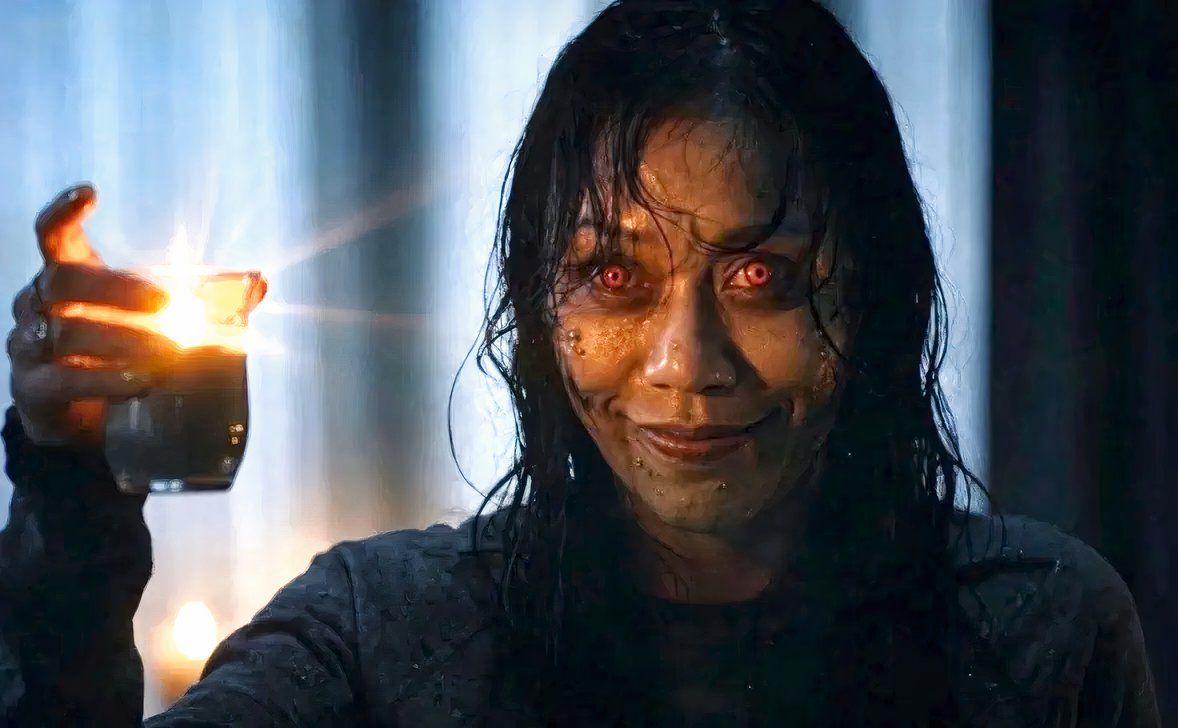
Frieda Luk's Edinburgh-premiered debut feature never quite sells you on its escalating magical-realist premise, but there's promise in her strange, offhand storytelling style. As the great Aretha Franklin taught us, it’s usually a backhanded approach to begin a critique with praise for the gowns. Or gown, in the case of “Sacred Creatures,” a microbudget hothouse drama otherwise not given to ostentatious styling.
Still, it’s a pretty defining dress. Worn for the bulk of the running time by enigmatic focal character Miriam (Olivia Luccardi), it’s both shapeless and striking, equal parts haute couture showstopper and military parachute, while even its color is hard to pin down: regal gold in some lights, bilious chartreuse in others. In a tall tale of a fey outsider elevated to cult-leader status by a passionate mob, costume designer Francesca Cibischino is to be commended on creating a garment that captures both the otherworldly godliness that others see in its wearer, and the girlish absurdity that we do.
In its peculiar changeability and clownish grandeur, the gown could also be a metaphor for Canadian writer-director Frieda Luk‘s intriguing, elusive debut feature — which itself never quite settles on a style or form, roving itchily between barbed social satire, mythic holy-fool fable and dysfunctional family drama. There is potential in all these modes, but for all the compelling ideas thrown into “Sacred Creatures,” most viewers won’t be altogether sure what to take away from it. Luk’s darkly airy tone, however, is genuinely, compellingly unusual, and should be an asset to future works with a slightly sturdier dramatic foundation.
Following a premiere in the main competition at Edinburgh, the film could pick up limited international distribution on the strength of its Euro-American cast and overall curiosity factor. The setting is semi-rural northern Italy, pretty far in all senses from the Tuscan sun: No tourist would linger long in this flat patchwork of farmland, light industry and retail parks, under seemingly perennially overcast ecru skies. The impressive, rambling country house in which the film is largely set really demands more glamorous surroundings, but its owner, middle-aged Italian artist Renzo (Antonio De Matteo), tries valiantly to make it a bohemian enclave, filling it with stark modern sculpture and hard-partying friends; his younger Canadian partner, Ray (James Cusati-Moyer), struggles to feel at home.
That air of discontent is ramped up when Ray’s two sisters descend on the house for a brittle family reunion. Toronto career woman Michelle (Romina d’Ugo) arrives bearing an assortment of anxieties and resentments; at least some of those relate to Miriam, the baby of the family, who recently spent some time in a mental health facility following an episode that her family would describe as a psychotic breakdown, and Miriam as a spiritual breakthrough. Though evidently fragile, Miriam projects a kind of beatific, benevolent calm, and it’s to the credit of Luccardi’s canny performance that it’s ambiguous whether she knows something that everyone else does not, or simply nothing at all.
Either way, it’s a magnetic quality: Renzo’s aspirational aunt (Pia Engelberth) is entranced by her at a party — where Miriam first dons the head-turning gown — and soon rustles up a coterie of local admirers to gather and fawn over the exotic, spectacularly dressed newcomer. When the dazed young woman reels off quotes from an obscure self-help book, her new acolytes take her words as gnomic wisdom. Her new following grows by the day, as Luk’s script drily observes just how little it takes to become an influencer, even outside the online sphere.
Extract — continue reading at the source.