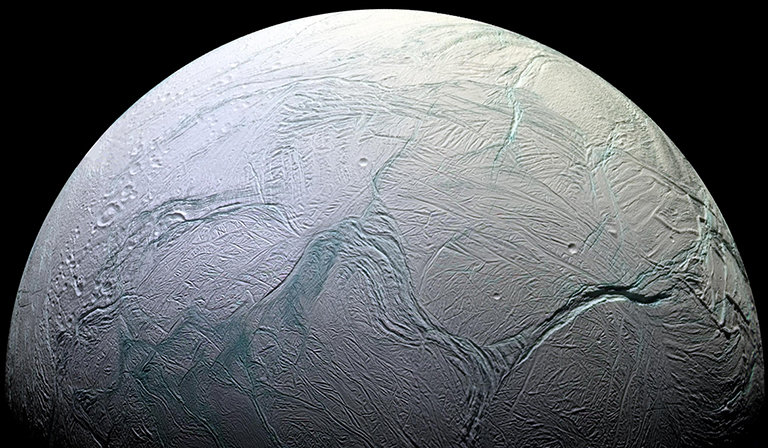
This article has been reviewed according to Science X's editorial process and policies. Editors have highlighted the following attributes while ensuring the content's credibility: The ocean beneath Saturn's moon Enceladus lies under kilometers of ice, but some of its contents do reach the surface. Jets near the south pole spray out water vapor and icy particles, offering a way to investigate the hidden ocean without drilling down to it.
The challenge is knowing which material preserves the most useful clues. A new laboratory study points to a possible target: salt crystals that trap tiny pockets of water as they grow during freezing. Liam Perera of Diamond Light Source in the United Kingdom and colleagues found these pockets inside natron, a sodium carbonate mineral expected to form on Enceladus.
Their findings, published in Communications Earth & Environment, suggest that the crystals could preserve information about the ocean's chemistry—and potentially traces of life, if any exists there. To determine which surface mineral would be the best candidate, the team cooled a solution containing sodium chloride and sodium carbonate, using powerful X-rays to watch it freeze. Three-dimensional images revealed the growing crystals and their interiors, and measurements of how the crystals scattered X-rays identified the minerals present.
As natron grew, it enclosed pockets of the surrounding fluid. Larger crystals were more likely to contain these pockets and tended to hold larger samples. Only about 3% of nearly 3,800 separated grains contained fluid inclusions, as researchers call them, but all 29 grains in the largest size category did.
That makes the crystals potentially useful containers: Each pocket could retain a small sample of the water present when it closed. There is an earthly reason to consider what else might be trapped. Earlier research on ancient salt deposits reported possible microbial cells preserved in fluid pockets inside crystals formed as water evaporated.
Although the new experiment shows that natron can trap fluid during freezing, whether it can also capture and preserve biological material remains untested. The authors propose that the surrounding mineral could help shield any such material from damaging radiation. A trapped sample would not necessarily be an unchanged drop of Enceladus's ocean, however.
Extract — continue reading at the source.