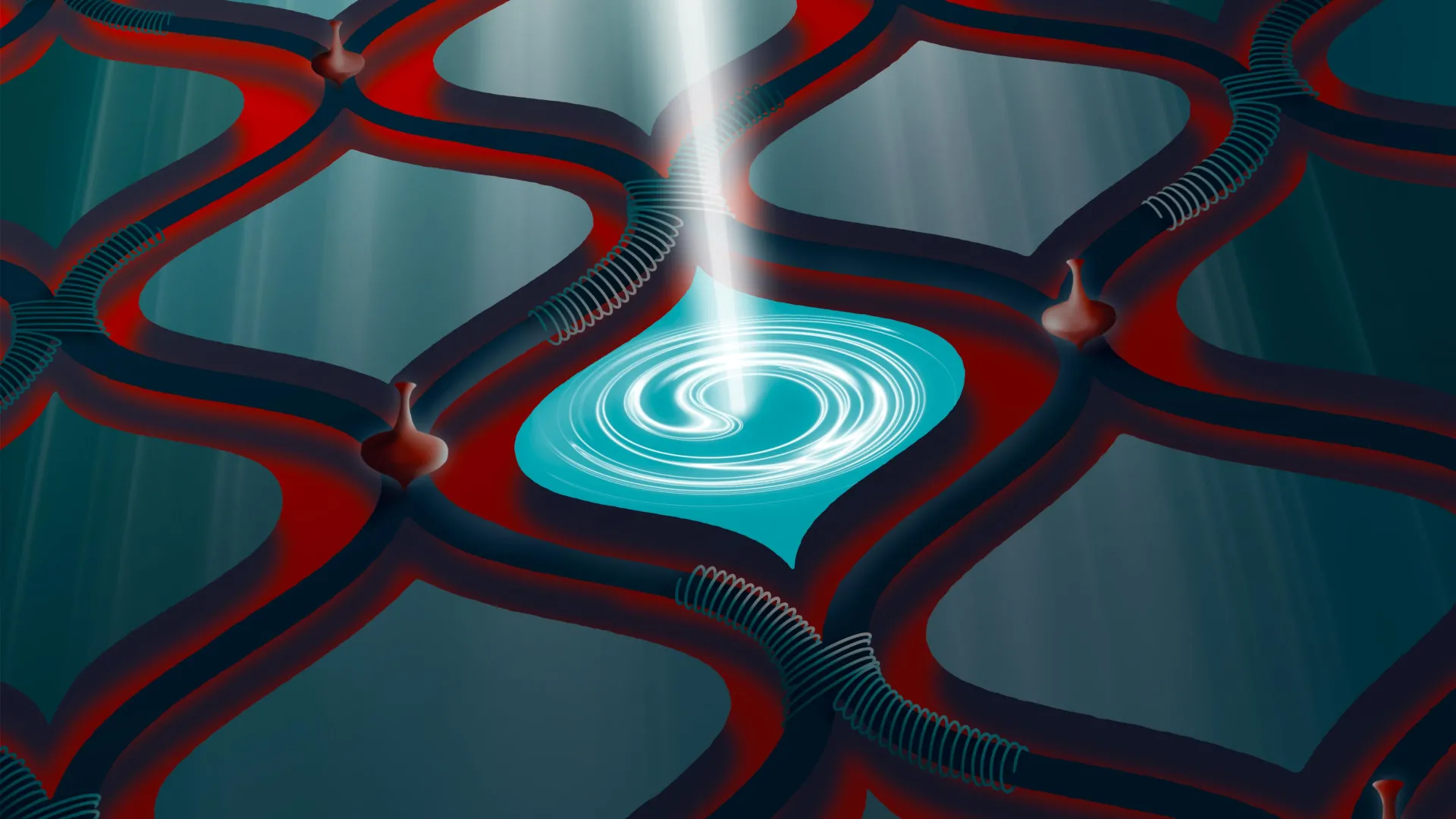
A particle does not have to pass through a magnetic field to be influenced by it. That surprising feature of quantum physics has now been recreated by researchers at the University of Oxford, who used a hybrid quantum computer to demonstrate how an invisible magnetic influence can bring a simulated particle's movement to a complete stop. The experiment reproduced a phenomenon known as the Aharonov-Bohm effect, in which a charged particle traveling around a region containing magnetic flux experiences a measurable change in its quantum state, even though its path never takes it through the magnetic field itself.
The Oxford team achieved this using a quantum system that combines qubits, the basic units of quantum information, with quantum oscillators, which represent vibrating motion. Their findings, published in Nature Physics, demonstrate how this combination could help scientists investigate fundamental interactions between matter and fields that are increasingly difficult to simulate using conventional computers. A Strange Quantum Effect Predicted in 1959 In everyday physics, a charged particle responds to the electric and magnetic fields it encounters.
Quantum mechanics, however, reveals that particles can behave in ways that have no straightforward counterpart in our ordinary experience. In 1959, physicists Yakir Aharonov and David Bohm predicted that a charged particle could be affected by magnetic flux even if it traveled entirely outside the region containing the magnetic field. Rather than experiencing a conventional magnetic force along its path, the particle would undergo a change in its quantum phase.
Quantum phase describes an aspect of a particle's wave behavior that influences how different possible paths interfere with one another. Although the phase itself is not directly visible, differences in phase can produce measurable effects. The prediction became known as the Aharonov-Bohm effect and was eventually verified in experiments involving real electrons.
It remains one of the clearest demonstrations that the quantum world operates according to rules that go beyond the familiar laws of classical physics. Researchers are now exploring how this phenomenon behaves in more complex theoretical systems known as lattice gauge theories. These theories describe how matter interacts with fields associated with fundamental forces.
They represent space as a grid, with matter located at individual points and fields associated with the connections between them. Such models are particularly important in particle physics and high-energy physics, where scientists study the basic particles and interactions that make up the universe. The challenge is that the mathematics becomes extraordinarily demanding as these systems grow more complicated.
Extract — continue reading at the source.


