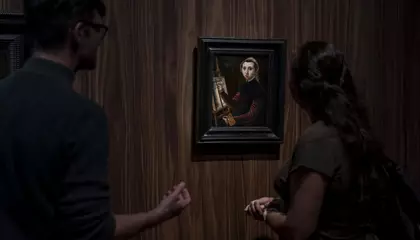
When Catharina van Hemessen was 20, she painted what is widely believed to be the earliest known self-portrait of an artist at work. In the 1548 scene, van Hemessen dons a black gown with red velvet sleeves and a modest hair covering. Instead of meeting the viewer’s gaze directly, she looks beyond them, her attention momentarily pulled away from the unfinished painting on her easel.
A Latin inscription at the top left of the panel proudly proclaims the artist’s authorship, declaring that “I, Catharina van Hemessen, painted myself.” The Flemish artist’s groundbreaking self-portrait paved the way for similarly self-referential paintings by later luminaries such as Artemisia Gentileschi, Vincent van Gogh and David Hockney. It’s “an important art-historical document, both in terms of the self-image of female painters and the practice of painting itself,” Ariane Mensger, a curator at the Kunstmuseum Basel in Switzerland, which houses the portrait, told the Art Newspaper’s Martin Bailey earlier this year. But van Hemessen’s contributions to the discipline have been largely overlooked in the nearly 500 years since she first started signing her work.
A new exhibition at the Snijders and Rockoxhuis museum in Antwerp seeks to restore van Hemessen to the art history canon. Titled “Van Hemessen and Father,” the show features more than 30 works—some of which have never been publicly displayed before—by the portraitist and her father, Jan van Hemessen, who helped her hone her craft. Van Hemessen’s “oeuvre has traditionally been defined by a small group of signed works,” but new research conducted for the exhibition indicates “that her contribution to her father’s workshop was more substantial than had previously been assumed,” the museum notes in a statement.
Experts found evidence of van Hemessen’s brushwork in the background figures who populate Jan’s larger-scale paintings. They also identified a previously hidden depiction of a kneeling woman beneath the surface of the artist’s Rest on the Flight Into Egypt. After the Antwerp exhibition closes in January 2027, a new version of the show focused solely on van Hemessen will travel to London, where it will be on view between March 4 and May 30.
Born into a well-to-do Antwerp family in 1528, van Hemessen was one of several artistically inclined siblings. (Her portrait of a woman playing the virginal, a member of the harpsichord family, is often identified as her sister, Christina.) As art historian Jennifer Courts wrote in a 2021 essay, van Hemessen’s birth in “the cultural and humanist center of Antwerp” likely meant that she had “far greater access to education than her southern counterparts” in the Low Countries, which encompassed modern-day Belgium, the Netherlands and Luxembourg. Information about van Hemessen’s life is sparse, but the findings presented in the exhibition support the idea that she developed her craft under her father’s tutelage. Her earliest known works date to 1548, the same year that she painted her self-portrait.
Of the 19 confirmed paintings in van Hemessen’s oeuvre, 14 are signed, the Times reports. The inscriptions are fairly similar, typically including the artist’s name and the year that she completed the scene. Most are small-scale, intimate portraits, but some depict religious scenes—also a hallmark of Jan’s work.
Extract — continue reading at the source.