Humans can swiftly learn to recognize visual objects after minimal exposure. Integrating new information with existing knowledge requires forming enduring neuronal representations to enable future recognition. Yet, the neuronal mechanisms in the human brain underlying such rapid perceptual changes remain unclear.
Here we recorded single-neuron activity in occipital cortex (OC) and medial temporal lobe (MTL) regions as participants rapidly learned to recognize degraded images. OC and MTL neurons modulated their activity to encode newly learned visual information and reshape perception. Population decoding revealed that OC neurons required additional processing time to resolve the identity of learned images, with delayed neuronal responses in the MTL.
Our findings suggest that OC supports recognition after rapid learning via extensive recurrent processing, potentially involving higher-order neocortical areas, without relying on feedback from MTL. These results provide mechanistic constraints for biologically plausible models of visual recognition and few-shot visual learning. Humans and other primates display a remarkable ability to visually recognize objects.
The main family of models to describe visual recognition capabilities is based on hierarchical deep neural networks1,2,3,4,5,6. Current instantiations of such networks are typically trained via backpropagation through millions of examples when learning from scratch, but also when fine tuning an existing pre-trained network7,8,9,10. In stark contrast to such long training processes, humans can swiftly learn to recognize visual objects with just one or a few exposures.
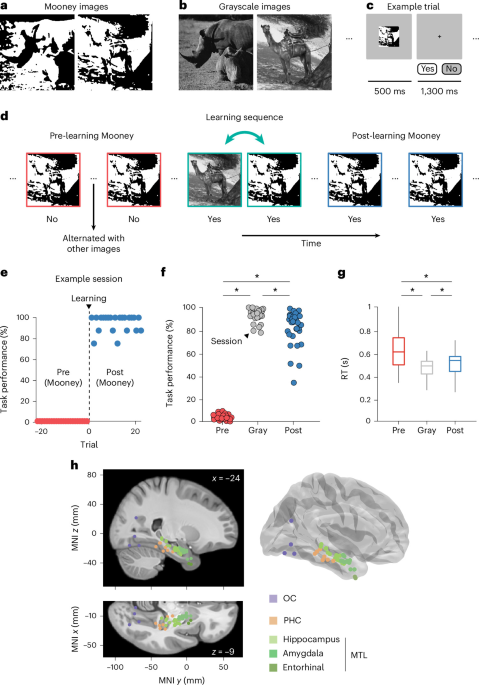
A striking example of rapid learning is the sudden recognition of a degraded black-and-white image of an object (Mooney image)11 (Fig. 1a). These degraded Mooney images tend to be unrecognizable initially. However, Mooney images become easily interpretable after a brief exposure to the original intact version of the image12,13,14 (Fig. 1b).
This perceptual ability for rapid learning develops gradually in late childhood (7–9 years) and is crucial for integrating new information with prior knowledge15,16. Rapid learning necessitates the formation of enduring neuronal signatures to enable subsequent recognition. Thus, newly acquired experience embedded in neural circuits dramatically shapes the perception of future incoming visual stimuli15,17,18,19.
Extract — continue reading at the source.


