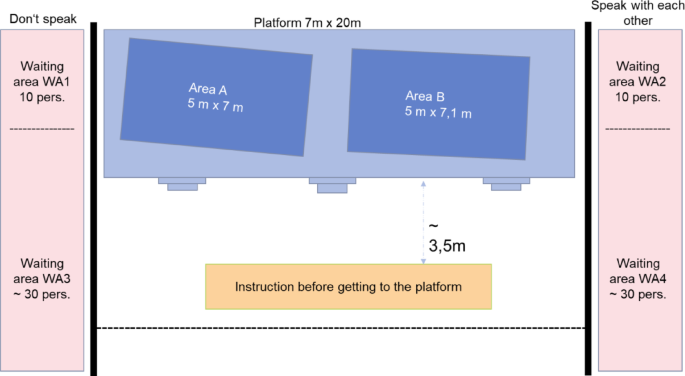
Uncertainty and limited access to information may trigger unpredictable group dynamics and unsafe movements in urban crowds. Although such situations are common in everyday life, the socio-psychological mechanisms that guide decision making in crowds have scarcely been explored, apart from the controversially discussed concept of contagion. This experimental study aims to make an initial empirical approximation of this issue by examining how (non-)communication and group size affect the duration and homogeneity of group-level decisions in an anonymous setting.
The results show that communication does not affect the duration of finding final solutions, but it can lead to both polarized or homogeneous outcomes. The absence of communication, on the other hand, may activate self-presentational concerns and lowers the possibility of highly homogeneous outcomes. These findings are discussed in light of mechanisms of social influence and conformity that could be identified through the videographic analysis of the experiments.
In everyday urban situations such as commuting, navigating train stations, or shopping in malls, we often make decisions automatically, based on routine and familiarity. However, when disruptions occur, such as unclear signage, technical failures, or contradictory movement cues, routines are interrupted. People hesitate and are forced to make conscious decisions, which can disrupt pedestrian flow and result in congestion or erratic movement patterns, potentially leading to high-density scenarios and increased risk of injury.
In these situations, it is often unclear what the correct decision is – especially when information is lacking or technical systems fail to provide up-to-date guidance. For this reason, it is crucial to understand what happens in crowds when the routine handling of a situation is no longer possible. From the socio-psychological perspective, the question arises as to how quickly people make decisions under uncertainty and how uniform those decisions are.
The aim of this study is therefore to explore how different social frameworks shape the dynamics of decision making in terms of speed and homogeneity within randomly assembled anonymous crowds under uncertain conditions. This article provides a first step toward integrating anonymity as a social construct into the study of spatial decision-making processes, thereby enabling a more complex perspective on decisions in crowd situations. These insights could offer new impulses for the field of crowd research.
Traditionally, contagion has been regarded as a key mechanism of social influence in crowds1,2,3,4, particularly in anonymous crowds where individuals are assumed to have no shared characteristics. In contrast, collective decision-making processes are typically attributed to team research, where the primary focus lies on the conditions for reaching consensus – an aspect rather irrelevant under conditions of anonymity. This study draws on quantitative team research as an initial framework to examine decision making in anonymous crowds.
Extract — continue reading at the source.