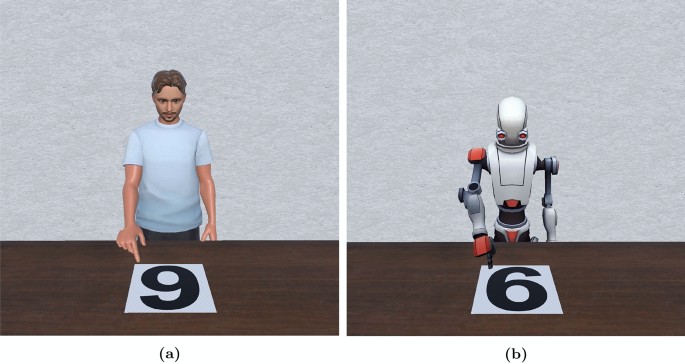
The purpose of this research was to extend the existing research to robotic avatars and VR as a medium for interaction. Study 1 confirmed that participants spontaneously adopt the perspective of both robotic and human avatars in static images, with no significant difference in VPT between the two agents. Study 2 compared VPT in video and VR conditions, revealing unexpectedly higher VPT in the video condition, despite VR’s greater sense of copresence.
We suspected that the spatial context of stimulus presentation played a critical role. Therefore, Study 3 further explored this by manipulating the placement of stimuli in the robot’s versus the shared environment, revealing that VPT was higher when stimuli were presented exclusively in the robot’s environment. This finding suggests that earlier VPT research may have a critical methodological limitation, as it did not account for spatial context in real human–robot interaction scenarios, which could limit its applicability to real-world robot interactions.
Perspective-taking is essential for effective human–human interaction (HHI). Even in simple social situations—such as asking someone to pass the salad at the dining table—individuals must consider what the other person can see and how they perceive the environment. Through perspective-taking, people can identify shared knowledge, reduce misunderstandings, and foster successful collaboration by understanding the unique visual experiences of others1,2,3,4.
Visual perspective-taking (VPT) refers to the ability to view the world from another person’s standpoint and understand their visual perception5. VPT can occur spontaneously without communication demands triggered by observing others in HHI6,7,8. Just like VPT is crucial in HHI, it also plays a fundamental role in human-robot interaction (HRI).
Researchers integrate technical implementations to enable robots to take the visual perspective of their human interaction partner9,10. Adopting a human perspective can be crucial for robots interacting with humans, as it enables them to comprehend, interpret, and respond to human intentions, facilitating effective communication, learning, and collaboration9,10,11,12,13. For instance, a robotic architecture has been proposed that allows robots to interpret the environment from both their own perspective and that of a human teacher.
This dual-perspective approach enhances the robot’s ability to overcome ambiguity in human demonstrations10. Similarly, previous research has shown that adopting a human viewpoint enables robots to think and act from a human perspective, fostering better dialogue and teamwork11. While earlier research in HRI has focused on the robot’s ability to take the human perspective, the ability of the human to take the robot’s perspective has gained increasing interest in recent years.
Extract — continue reading at the source.


