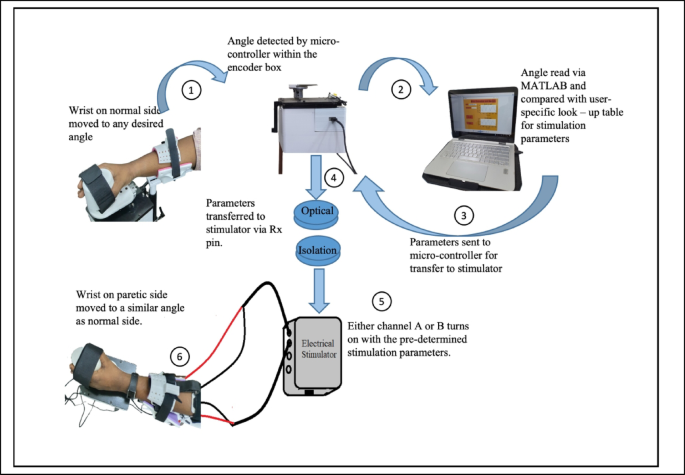
Numerous therapeutic interventions have been explored for stroke related dysfunctions with various degrees of success; however, rehabilitation of the stroke-affected upper limb and hand still remains a challenge. Focus has now shifted to rehabilitative training devices that augment neuroplasticity and improve motor control. This article discusses a usability study carried out on a novel device called the encoder-controlled FES.
It uses flexion and extension of the unaffected wrist to control the delivery of stimulation to the stroke affected wrist, resulting in a mirrored activity of the unaffected wrist on the stroke-affected wrist. The hypothesis was that a combination of bilateral arm training and FES mediated mirrored wrist activity will help the brain to relearn the activity and improve motor control. A preliminary usability study was conducted to check the acceptability of the device being used in a clinical setting.
The device was used by 20 patients with stroke and 15 occupational/physiotherapists in a single session each. After the session, patients filled in three feedback forms – the System Usability Scale (SUS), the User Experience Questionnaire (UEQ) and an EC-FES patient questionnaire; the therapists were given an EC-FES therapist questionnaire. The mean scores obtained for the SUS test and patient questionnaire were 74 ± 16.3, and 78.26 ± 8.54 respectively.
All the questions in the UEQ were answered positively, conveying that the device meets participants expectations, and the mean score obtained for the therapist questionnaire was 75.3 ± 14.93. The scores suggest that the device may be useable in a clinical setting and paves the way for further definitive trials. Stroke is a significant global health issue, often resulting in death or long-term disability, and contributing to a substantial disease burden1.
In India, stroke is the major contributor to disability adjusted life years (DALYs), as estimated by the Indian Global Disease study 1990 to 20192. Only 10%-20% of strokes lead to death, and of the survivors, 80% have motor impairment and over 30% have long-term persisting disability3,4,5. The primary goal of stroke rehabilitation is to assist in functional recovery and regain independence and hence should be considered early during the recovery cycle6.
Current rehabilitation strategies focus on exploiting the ability of the brain to relearn activities by introducing or creating interventions that lead to the desired, neuroplastic changes in the brain7. Among interventions that impact synaptic plasticity is functional electrical stimulation (FES)8,9,10. Combining FES with bilateral hand activities capitalizes on the synergistic benefits of these two interventions11.
Extract — continue reading at the source.


